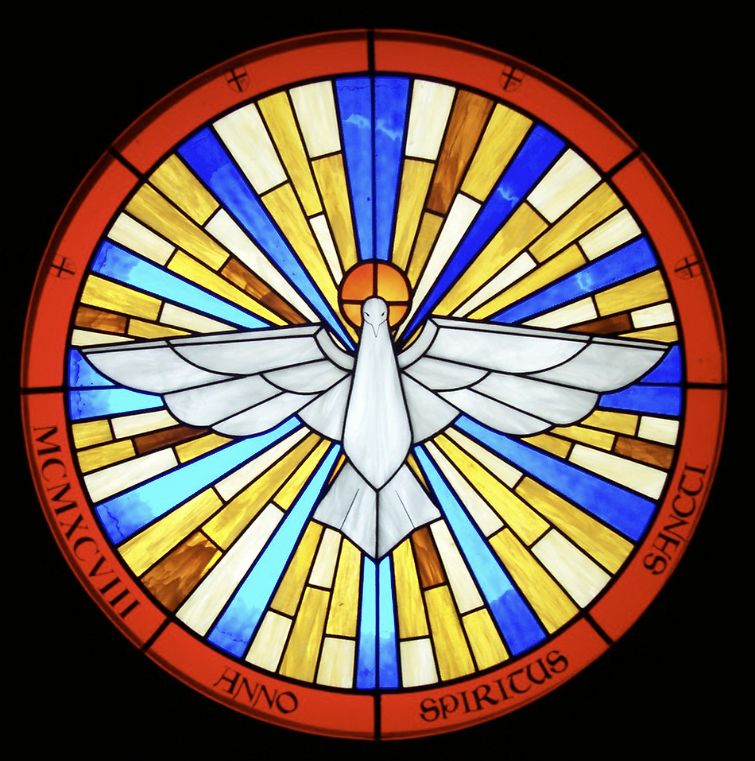

A sermon for Headingley St Michael, Pentecost, 24 May 2026
Readings: Joel 2:21-32; Acts 2:14-38
We are living, as I’m sure you will all agree, in worrying times. Whether it is political instability, economics or the climate emergency, the present is unsettling and the future very uncertain. Prospects are bleak at best. Where is God in all this, we may ask? I’m not here to offer political comment or practical solutions. But I reckon that people were asking the same question in Joel’s time.
The book is one of the shortest in the Bible. We know nothing about its author. Even the date is uncertain: between the sixth and fourth centuries before Christ, perhaps. The book is about the Word of God that cane to Joel at a time of national crisis. He describes a terrible plague of locusts that had devastated all the crops and left people without food, jobs or hope. In the last chapter there is judgement on Judah’s national enemies, before restoration of the land. It may be that the plague of locusts was a real one, or it may be merely a metaphor for the way an invading army destroyed people and farmland alike.
Either way, the story arc of Joel is familiar from other parts of the Bible: a nation rebels against God, God pronounces judgement and causes disaster to come upon them, a prophet calls for repentance, the people pray, God delivers them from their peril, and blesses them again with fruitfulness of crops and children. And repeat. What God’s people really need is something to lift them out of that cycle of sin, judgement and repentance. What they need is true holiness.
In the middle of the book, though, is a prophecy unlike any other in the Old Testament, and one that Peter quotes extensively in his sermon on the day of Pentecost. Through the Old Testament, there are occasional references to ‘the Spirit of the Lord’ coming upon an individual to empower them for a particular task: Samson is gifted with great strength, Solomon with great wisdom, Gideon with great courage, David with the gifts needed for kingship but also a spirit of worship. Many others with words of prophecy. But not everyone.
This prophecy of Joel, however, looks forward to a time when God’s Spirit would be given to all people. Not just rare individuals, not just men, not just adults. Everyone. And as we move into New Testament times, there is a change. This third person of the Trinity, as we now understand him, is now called the ‘Holy Spirit’. That term only appears twice in the Old Testament, as far as I know: in Psalm 51, and in Isaiah 58 where it refers to God’s power present in Moses. But from the day of Pentecost onwards, the Holy Spirit is the usual term, and he is available to anyone who follows the way of Christ.
The Holy Spirit, then, or to put it another way, the Spirit of Holiness. I am grateful to David for picking that hymn this evening, because it fits my theme well. I’m going to look briefly at a few phrases from the verses of this hymn and what they tell us about the work of the Spirit. In other words, what is holiness?
Verse 1: ‘You came to interpret and teach us effectively’. One of the roles of the Holy Spirit is to help us understand the Bible. Both the Old Testament – the story of God’s people and his loving-kindness in dealing with them – and the New – the story of Jesus and the early Church. There are any number of interpretations of the Bible out there, especially in these days of social media when it’s hard to distinguish between genuine scholarship and a random post by someone with little understanding or ulterior motives.
Christians can, of course, agree to differ on matters of interpretation, to quite a large extent. But it’s all too easy for people to be led astray into what are clearly un-Christian beliefs and practices. If we come across a new interpretation of part of the Bible, it is wise to ask the Holy Spirit to guide us. Is this teaching consistent with what we know of the Holy Spirit’s work? Does it encourage us to reach out to others with a message of God’s love and forgiveness? Does it honour Jesus as Messiah, as Son of God, Saviour and Lord? Does it promote harmony and unity in the Church? Does it allow us the freedom in Christ as forgiven people that Paul writes of? Or does it promote separation, strictness, a constant sense of guilt, obedience to human leaders and their rules? Those are not the way of true holiness.
Verse 2: ‘You came with gifts to supply all our poverty, pouring your love on the Church in her need’. That is what the Apostles experienced at Pentecost and afterwards. Each spoke in different tongues so that everyone in the crowd could hear the good news in their own language. And to each person were given gifts to enable them to take their place in the newly-born Church: some as evangelists, some as teachers and prophets, some as hosts for congregations in their houses, some with practical gifts like those of Dorcas. Also, many were given a spirit of generosity to supply the Church with its financial needs. Today, we need to ask again for the Holy Spirit to give us the needful gifts so that each of us can take our place in the local or worldwide Church.
Verse 3: ‘Warning of dangers, directing us home’. The Holy Spirit is the Spirit of God’s goodness. It is only with God’s own spirit dwelling in us that we can hope to achieve anything close to the goodness of God. In the Sermon on the Mount, Jesus challenges his hearers to ‘Be perfect, as your heavenly Father is perfect.’ (Matthew 5:48).
But goodness is always opposed by evil. In Acts 2:23, Peter addresses those who had been present in Jerusalem in Holy Week: ‘Jesus was handed over to you by God’s deliberate plan and foreknowledge; and you, with the help of wicked men, put him to death by nailing him to the cross.’ He had seen for himself how easily the same people who had chanted Hosanna! one week were calling Crucify! the next. In his sermon, Peter went on to issue an urgent call to repentance, for people to open themselves to the same Holy Spirit they had witnessed come upon the apostles, to save them from evil and enable them to break free of the cycle of sin and judgement.
As I said at the outset, we live in unsettling, even dangerous times. There is no shortage of evil in the world today, openly manifesting itself in corruption, lies, hatred and violence of all kinds. We have seen this week how it sometimes pretends to holiness by assuming a false Christian identity. But again, if we are open to the Holy Spirit, we will know when we see true Christianity in love and service offered to others, and when we see fake faith that seeks to dominate and divide.
Lastly, in the chorus of the hymn, we address the Holy Spirit as ‘Strength of our serving and joy of our worshipping’. We may often doubt – certainly I do – whether the Holy Spirit is truly in us, because not everyone is given obviously ‘spiritual’ gifts such as tongues, discernment or prophecy. But this is a good test: ask yourself, ‘do I feel empowered and strengthened when I set myself to do something good for God?’ and ‘Do I feel joy when I am worshipping him?’ If the answers are ‘yes’, then the Holy Spirit is in you.
Four ways, then, of understanding the Spirit of Holiness in these difficult times. Four tests of whether we have the Holy Spirit in us: being inspired to joyful worship; being able to interpret the Bible for our own situation; being directed into God’s way, avoiding the dangers of heresy; and receiving gifts to serve him in the work to which we are called.
Between them, these four works of the Spirit help us to achieve a balanced and fruitful Christian life: worship, study & prayer, holy living, and practical service. True holiness from the indwelling of the Holy Spirit is both our coping mechanism in an unstable world, and at last, an escape from that cycle of sin and judgement with which we began. On this Pentecost Sunday, then, let us continually pray: ‘Come, Holy Spirit, come, and make us perfect as our heavenly father is perfect’. Amen.
Featured image: window in the Pontifical College in Jerusalem. © J Voitus / Flickr