
For Communion at St Peter, Bramley, Sunday 22 February 2026.
Text: John 8:1-11, 1 John 4:18
Featured image: AI generated.
As Julia [our priest] said at the start of the service, our Sunday services through Lent are looking at the overall theme of ‘Complete Unity’ as we live and learn together. These are based on what the Church of England calls its ‘six pastoral principles’, ways in which we as a congregation can be pastorally supportive of each other, and of all the people of Bramley whom we are called to serve.
Today, we are thinking about ‘casting out fear and building confidence’. Opposite emotions, in many ways. There are many reasons why any one of us might from time to time feal fearful. Sometimes it is the fear of harm. What other people might do to us, perhaps because they have already done it before. Violence, name calling, discrimination, all the different forms that abuse takes. That kind of fear takes away our confidence in living as we wish. Knowing that the person you fear might turn up at any time, or that you might accidentally do or say something that triggers them.
But fear can take other forms as well. It can be fear of what we think other people know about us, and what they think of us because of that. That type of fear has another name: unworthiness. And it takes away our confidence in who we are. I’ll come back to that shortly.
Fear can also mean imagining of what other people think of us, or what consequences there might be if they find us out, because of what we have genuinely done wrong. That sort of fear also has a name: shame. It takes away our confidence in being open and honest with other people, with God, or sometimes even with ourselves.
Fear of harm; A sense of unworthiness because of what others think of us; A sense of shame because of what we have done. Any of these fears will prevent us from having the ‘fullness of life’ that Jesus came to bring.
If we look now at our Gospel story today, I reckon we can see all of these at work. Let’s give this woman a name, though she is not named in the Bible. Let’s call her Hannah. Hannah was certainly in fear of the men who brought her to Jesus. These leaders were confronting Jesus where their understanding of Jewish law and God’s grace were in conflict with his. Hannah was for them merely an exhibit in this argument: would he support the death sentence they wanted to impose, or not? Hannah stood in fear of her life before the men who wanted to stone her. She had no confidence in any kind of legal process.
There is also a sense of unworthiness. Hannah was on the back foot, caught out in her affair with some unnamed man. I expect she regretted ever having started it or agreed to it – assuming that she consented to the relationship in the first place. It did not help that this was a patriarchal society: one where men held all the power and a woman was not accepted as a witness. She had no confidence in her own ability to live in accordance with Jewish teaching.
But there is also a strong element of shame. There is no suggestion that Hannah was innocent; Jesus does not condemn her, but recognises that she has sinned. How would you feel if your sexual sin was being discussed in the public square? The whole city would soon know what she had been up to. No doubt she wanted the whole episode to be over with. Maybe she even wanted to curl up and die. Most of the images of this story I have seen show her like this, lying on the ground in shame. But the Bible does not say that. It says she was made to stand before her accusers, in full view of the crowd. She had no confidence in being able to be friends with anyone again.
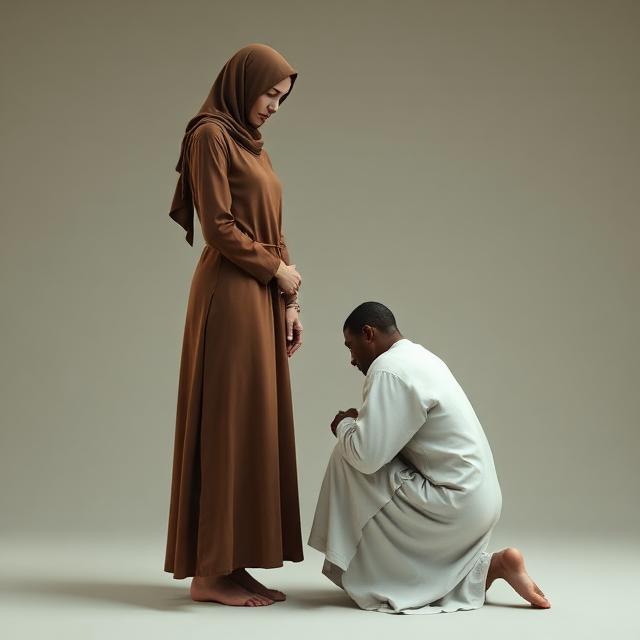
We don’t know whether Hannah had met Jesus before. If not, she may have assumed him to be another rabbi who would add to her condemnation. But instead of agreeing with the Pharisees that she should be stoned, he stoops down while she remains standing: he puts her in the stronger position. And by doing so, he begins the process of restoring her confidence. ‘I am less important than you’, he seems to be implying.
He then stands up to face up to the Pharisees and challenge their own apparent confidence in themselves. Twice he does this: stooping to kneel before Hannah, standing to challenge the men. ‘Whoever is without sin, let him cast the first stone’. Silence reigned as they pondered their own position. Which of them was afraid of being named and shamed for their own sins? Which of them was made to feel ashamed of what they were doing?
After all the men had slunk away, Jesus was left alone with Hannah, and the process of healing could continue. By sending the men away, he cast out her fear of being stoned. By refusing to condemn her sin, he ended her sense of shame. She could go away, as one priest memorably said to us, to the ‘Land of Begin-Again’. Men in their society did not normally talk directly and alone to a woman outside their family, but by talking to her one-to-one as an equal he removed her sense of unworthiness and gave her the confidence to carry on with her life. Who knows, Hannah may have become one of his disciples, along with Mary Magdalene, Joanna and other women?
Let me now come back in time to Yorkshire in the 2020s and another story about encountering Jesus. Jack is a real person, who I met recently. Jack is in his 80s, with various health problems, and married for a long time; his wife is a committed Christian, but Jack didn’t often go to church with her. Then their church started having healing services. We’re not talking anything dramatic, just praying for people in their various needs. On the second occasion that his wife invited him to the healing service, he agreed.
And something happened to Jack that day. He didn’t walk away freed from physical disability. But came to realise that he had lived for a long time with a sense of unworthiness. I don’t know what may have gone on in his life to cause it. But he didn’t feel worthy of being in church, he feared what God, or other people, might say. And as he was prayed for, he suddenly felt this sense of unworthiness lifted, he became aware of God’s love in a new way. “I had always believed in God”, he told me, “but now I truly have faith in him”. Jack felt so encouraged that he became a regular worshiper at church, and at the age of about 82 was finally confirmed by the Bishop, the eldest of those being confirmed that day.
A wider question is what we, as a church community, are doing to create a climate of confidence, where people can feel able to come with all their fears and uncertainties and be released from them. It starts with the warm and unquestioning welcome that we offer to anyone who comes for the first time. It continues with the conversations we have, listening to people’s stories, being supportive and not judging them. It flows through our worship, prayer ministry, family activities, small groups, where people can open up about their fears and find help: in moving from fear to peace, from shame to self-esteem, from unworthiness to knowing themselves worthy through what Jesus Christ has done for us. In both these stories, we see Jesus come alongside those who have fears, who feel unworthy, who experience shame, because he wants to cast it out and build up confidence. Amen.