
A sermon for St Peter, Bramley - 29 December 2024
Reading: Colossians 3:12-17
This is our final act of worship of 2024. As with last year, it includes the covenant prayer. This is the first of three forms of commitment that we will be marking through the winter. On 26th January we have the Vision Day in which we draw on the PCC’s thoughts on our church’s activities and purpose in the coming year and commit our time and talents to bring the vision about. Then in February we have the Gift Day when we commit a share of our money to the Church’s work, as God leads us.
Before we commit our time, talents and money to this vision, it’s important to commit ourselves, our innermost being, to God. For it is God who gives us the vision, God who gives the gifts to make it happen, and God who binds us together as once community. That’s what today’s service is about.
Paul’s letter to the Colossians refers to several layers – love, peace and several other virtues. Elsewhere he talks about the armour of God. So I’m going to build up a word-picture of these layers as a model of Christian commitment. Let’s unpack these verses to see what they might say to us as we make this annual commitment of faith. I’m taking them in a different order to how they appear in the text. You may wish to refer to your service booklet.
I’ll start with verse 15: ‘Let the peace of Christ rule in your hearts, to which indeed you were called in the one body.’ In classical thought, the ‘heart’ did not mean the place where we feel emotions. Rather, it meant the place where soul, mind and body come together, where we feel ourselves to be a complete person.[i] Deep down in the core of our being is that heart-space, into which we withdraw in prayer. So what Paul seems to be saying is that when we pray in that heart-space, giving thanks to God and feeling the peace of Christ – ‘that peace which the world cannot give’ as the liturgy of Evensong puts it[ii] – we establish a sort of solid core to the Christian life, round which everythng else can be wrapped. Without that Peace of Christ, we risk being hollow and liable to collapse under pressure. Just as Mary ‘treasured all these things and pondered them in her heart’[iii], for her to cope with events later in Jesus’ life.
If that was the end of the story, we would merely be contemplatives with nothing to offer the world around us. So establishing Christ’s peace in our heart is only the start. We need to turn from that inward-facing form of spirituality, confident in that inner peace but seeking to engage with other people.
So, to verses 12 and 13: ‘As God’s chosen ones, holy and beloved, clothe yourselves with compassion, kindness, humility, meekness, and patience.’ And adding, ‘forgive each other’. These virtues are what are needed to be Christ to the people around us: leading by serving as he did, meeting people’s needs even at cost to ourselves, as he did. To constantly be compassionate, kind, humble, meek, patient and forgiving is not easy, and if we can achieve it, it’s mentally and emotionally draining. I have huge respect and admiration for the volunteers at the sharp end of our foodbank ministry, bringing all these virtues to bear when dealing with people who are often crumpled under the pressure of difficult circumstances that drive them into poverty. Or anyone else in a similar situation: paramedics, therapists and so on. Yet they are being Christ to the people they meet.
These virtues, so necessary for a fruitful Christian ministry, are what the HR manager in my previous job called ‘soft skills’. Paul talks about ‘clothing ourselves’ with them. If we stick with my idea of layering, these are a soft, tender layer around the solid core of our heart, our inner prayer life. And of course it is Christ who offers these clothes, this layer of soft interpersonal skills.
So, we have a firm core of Christ’s peace, surrounded by a soft layer of Christian virtue. ‘Above all’, Paul writes in verse 14, ‘Above all, clothe yourselves with love, which binds everything together in perfect harmony.’ So we can picture another layer, binding the soft skills or virtues to keep them effective. This layer is love – αγαπή – that particularly Christian form of self-giving love for others which summarises all the other virtues. I see this as not a solid layer, but some form of permeable mesh or netting which keeps those vulnerable, soft skills from falling apart, while allowing the peace of Christ to permeate outwards. For love is always about keeping our heart open, not closed.
So far, then, we have the solid core of peace, the soft mantle of compassion and other virtues, where the actual work of the Church in the community takes place, and the netting of love keeping them in control. You may also be familiar, though, with Paul’s other image in the letter to the Ephesians of the ‘armour of God’[iv] – truth, righteousness, the gospel, faith, salvation, Spirit and Word. We’re back to hard language here, as these ‘tools of the trade’ of Christian ministry are compared to the elements of a Roman soldier’s armour. In my model, I see these as a hard shell outside even the love-netting.
This outer armour is needed because we live in a fallen world, in fact, let’s be honest, an evil world, or at least a world in which evil contends against goodness. Without an acknowledgement of this, all our inner peace and soft compassion would be very vulerable indeed. When the person we’re trying so hard to help refuses it; when the good work we have built up is destroyed in a single night by thieves or vandals; when our faith in humanity is shattered by the revelation that the leader we admired is secretly an abuser: then, it’s all too easy to give in, to buckle under the pressure of evil. Which is why it’s vital we keep this armour on: always remembering that the Gospel that we preach is not a man-made myth but God’s own revelation, that our own personal salvation is assured no matter what life throws at us; bringing all our difficulties to Jesus and asking for the Holy Spirit to come into that situation.
There we have it: four layers of our personality that together make for effective Christian service. The solid core of Christ’s peace in our inner being; the soft skills of compassion, kindness, humility, meekness, patience and forgiveness; the permeable layer of αγαπή love binding them together; and the hard outer casing of spiritual armour against the evil in the world. As we come to say the Covenant prayer, we offer back to God what he has given us to use in his service: his peace in our heart, his love for all people, the gifts and the armour he has given us.
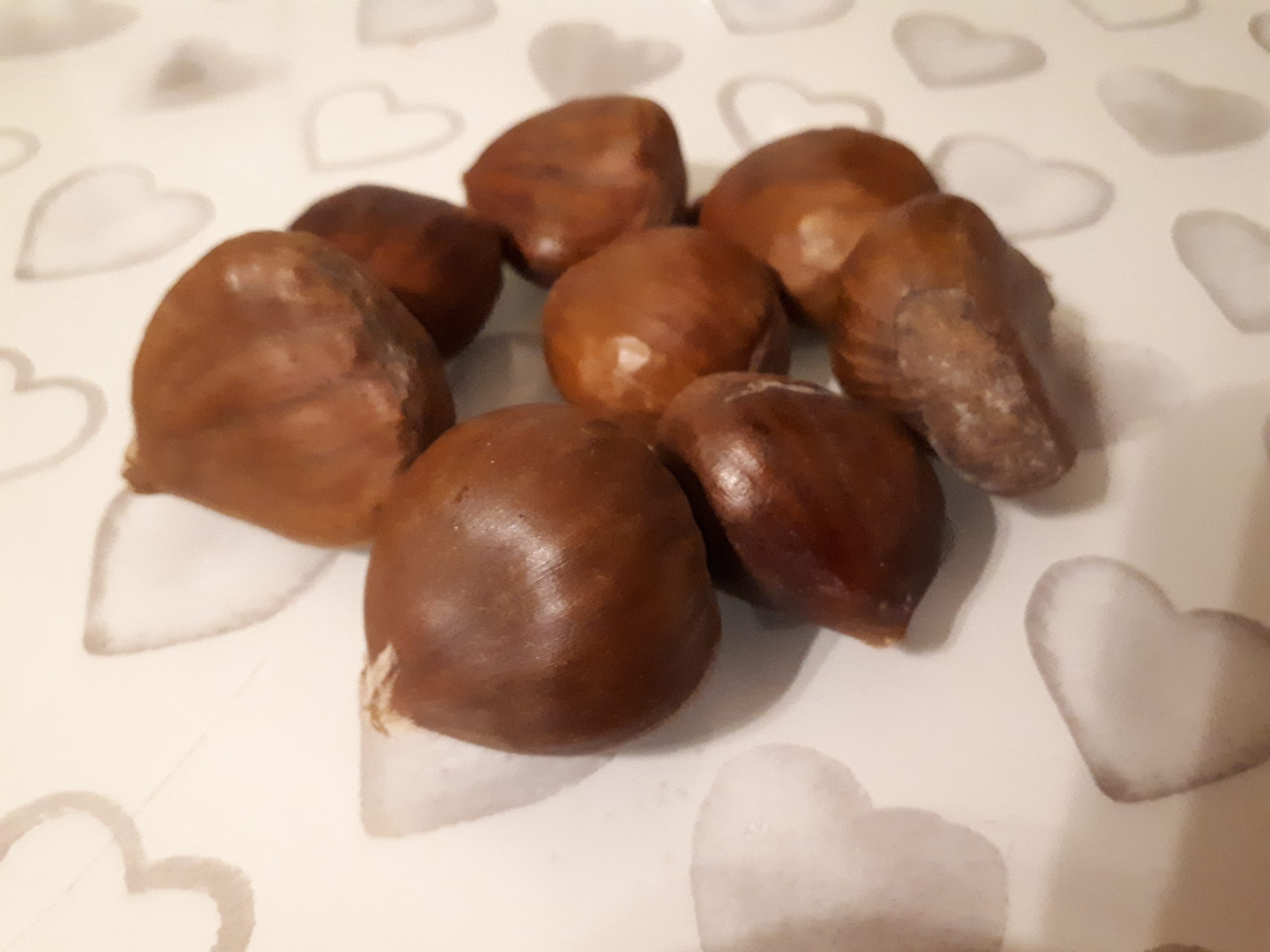
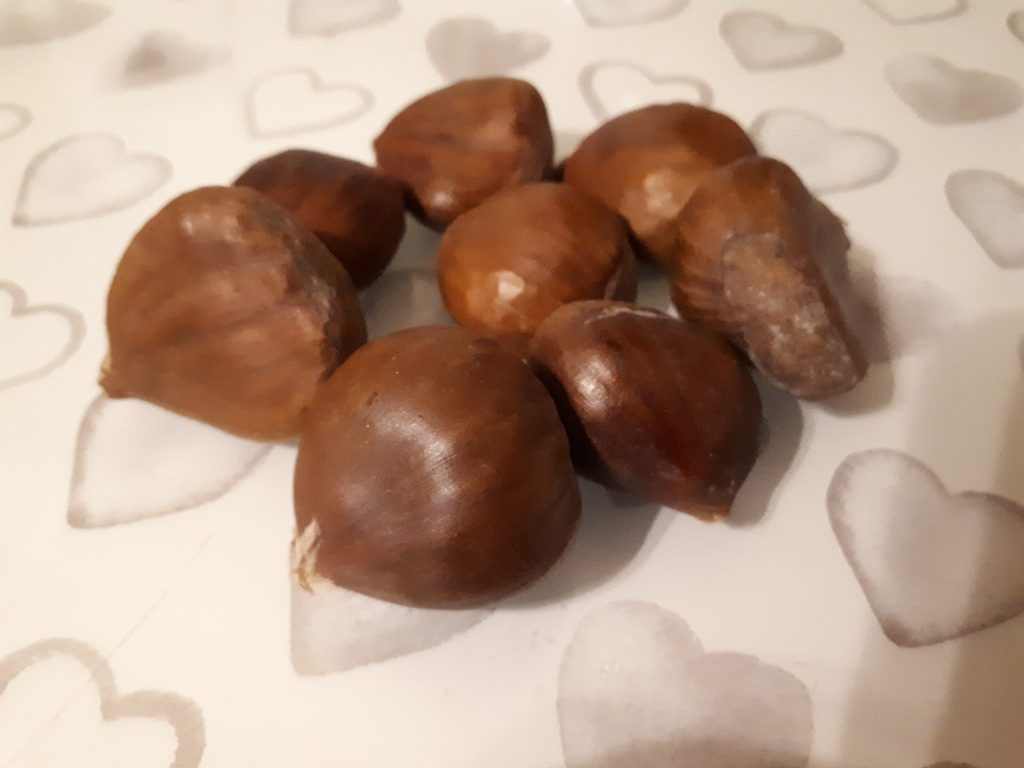
I thought about what it actually looks like in practice – what might be a symbol to remind us of all this. Being Christmas, I settled on these: chestnuts. Not four layers, exactly, but they have the solid armour outer layer making them indestructible when raw. Yet, when roasted, this opens to reveal the soft, sweet inner flesh. I invite you to take some of these, roast them as a seasonal treat, and meditate on God’s provision as you prepare for the new year ahead. O taste and see that the Lord is good![v] Amen.
[i] See for example ‘Just This’, Richard Rohr, SPCK 2018 p.102
[ii] Collect for Peace, from the Order for Evening Prayer in the Book of Common Prayer
[iii] Luke 2:19, Jerusalem Bible
[iv] Ephesians 6:13-17, NRSV
[v] Psalm 34:8