
Common Ground Song 27 ‘Comes Mary to the Grave’
Words: Michael Perry /Music: David Iliff © Jubilate Hymns
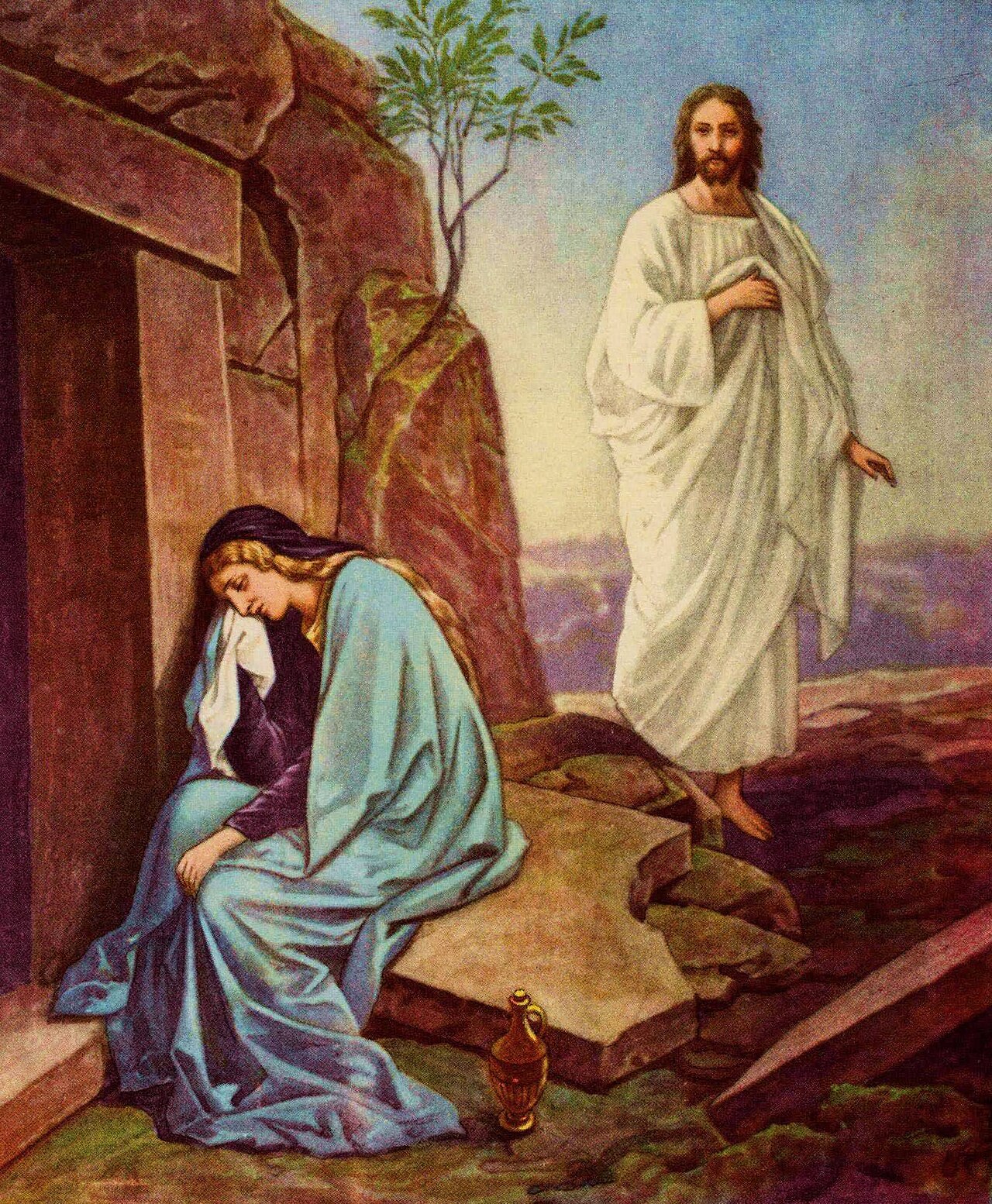
Featured image: ‘Jesus resurrected and Mary Magdalene’, Heinrich Hofmann, public domain
I could not find a recording of the whole hymn online, although the first verse only can be heard here and the words to all three verses read here. The editors note that it is in a ‘rare metre’ (6.7.7.11) which means it does not fit to any other hymn tune.
This is clearly an Easter hymn, but very different from the joyful tone of most hymns at this season. The melody, in D minor, mostly flows gently up and down in single tone steps, the other parts in the four-part setting either following the melody in harmony, or in counterpoint. The overall effect is to keep the mood subdued.
That is appropriate, for it is a meditation on the encounter between Mary Magdalene and Jesus in the Easter garden. Yes, the resurrection of Christ is a wonderful, joyful, powerful miracle that we must celebrate. And yet it remains a mystery in every sense of the word: a happening that ‘science’ cannot explain, for this is both a physical and a spiritual event; and also in the theological sense, a symbol of a much deeper truth, that death is not the end of life, and the physical world that we see and feel is only part of the wider existence of God’s creation.
There is no end to the making of books about the Resurrection, as Ecclesiastes would agree. But all this would be too much, and unnecessary, for Mary at that moment in the dawn light of Easter morning when ‘no singing bird has spoken, nor has the world awoken’. She just needed to know that the man she loved was alive, that he still knew and loved her, and that she had such a special place in his heart that she was the one chosen to be the first witness of the Resurrection and first bearer of the good news: the ‘apostle to the Apostles’ as she has sometimes been called.
But before he sends her, Jesus first needs to acknowledge the real and deep grief that Mary suffers. Grief that cannot simply be vanished away with a word or a flash of light, or even the words of an angel. Jesus here reveals his eternal divinity as conqueror of death, yet in this moment he maintains his humanity, coming alongside her and offering the deeply personal ministering of compassion to a bereaved friend. ‘Why, Mary, are you crying?’ he asks (in this hymn), knowing the answer but giving her the opportunity to respond in her own words. ‘She turns with joy, “My Lord! My Love!” replying’.
The words of the third verse are mor e positive, and bring us, the singers, into the experience. ‘With Mary on this day we join our voices praising the God of Jesus’ raising’. Yet the hymn maintains the same minor key. As we sing with joy of the Resurrection, we must also acknowledge the pain of the world that he came to save, and remain in awe and humility as we attempt to take in the mystery.