

Sermon for Bramley St Peter, 23 February 2025
One of a series of six sermons on being rooted in faith.
Bible readings: John 4:19-26 / 1 Peter 2:4-10
Has anyone ever asked you, “what sort of church do you go to?” I’ve certainly heard that question many times. But before answering, I need to find out what the questioner thinks they are asking. They might mean, ‘Is it a wonderful large gothic building with stained glass and marble statues everywhere, or an ancient but plainly furnished chapel, or some brutalist modern building of no architectural merit?’ Or, they might mean, ‘Do you have incense and processions and vestments, or does your pastor just wear a suit and dispense with any ceremony?’ Or they might even mean, ‘Do you have a four-part choir that sings old hymns and anthems, or is your worship very contemporary with guitars and drums?’
All these are valid questions, and just go to show what a variety of churches and forms of worship there is out there. And we haven’t even touched on silent Quakers or Orthodox chant…
Whatever the questioner thinks they are asking, what it comes down to is ‘how and where do you worship God?’ And that’s the discussion that Jesus had with this unnamed Samaritan woman one hot afternoon.
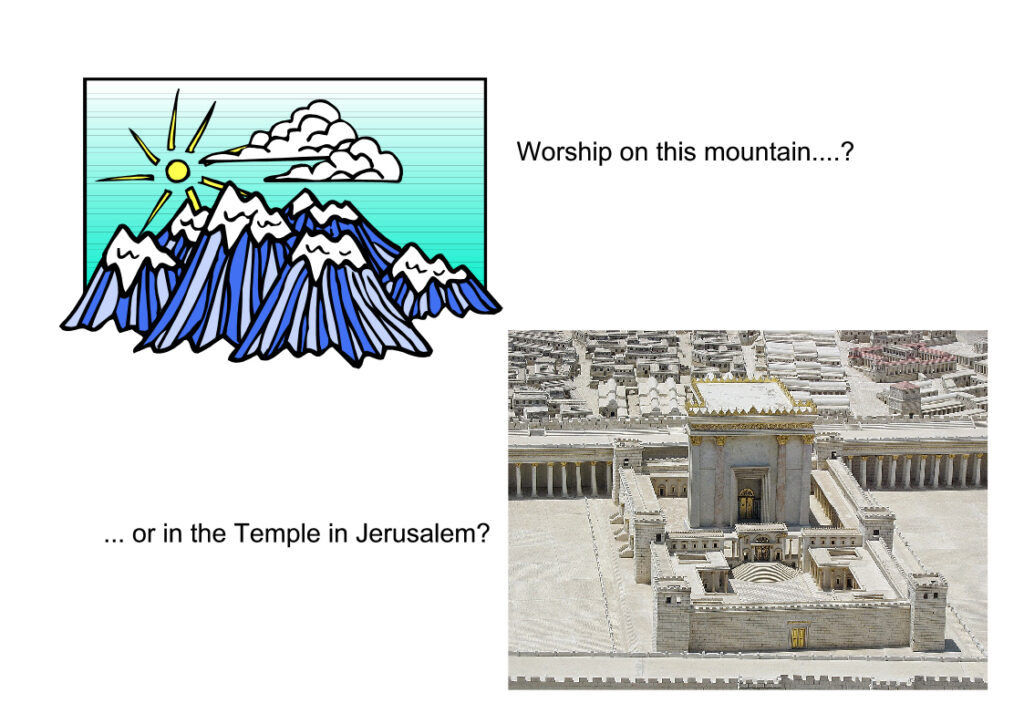
The woman’s question was a leading one, really. She was trying to get Jesus into an old argument between Jews and Samaritans. The two both derived their religion from that of Abraham, so there was no doubt that they worshiped the same, one, true God, but each claimed their sacred hill as the one on which Abraham had nearly sacrificed Isaac.[i] Each once had an ancient temple that had been destroyed: The Jewish temple in Jerusalem was still in the process of being rebuilt, a vast and magnificent building for its priests, singers and complex rules about sacrifice and prayers. The Samaritans hadn’t rebuilt theirs and we know little about how they worshiped at the time.
But Jesus wasn’t going to get drawn into that sort of argument. He wanted to get to the basics of what the woman really needed to know. Which was not what sort of building we should use for worship, or whether the old is better than the new, but what it really means to be a worshiper of God. After all, Abraham, their common ancestor, had no more than a tent in which to encounter God. His response was one that we all need to heed: ‘God is spirit, and those who worship him must worship in spirit and truth.’[ii] That says nothing about the tent or temple where we meet, and everything about our attitude.

Peter also understood perfectly well that the Jerusalem Temple no longer held the same importance for Christians that it had for Jews: his readers were mostly non Jews themselves. So when he writes of them – and us - being ‘living stones built into a spiritual house’[iii] he is using picture language – an analogy. The spiritual house is indeed the Church – but not in the sense of the building we meet in. Rather, the picture is of Jesus being like the cornerstone or foundation stone: large, strong and perfectly straight and vertical, without which the whole building might fall down, or at least lean precariously. If our faith, our worship, is not based accurately on Jesus then it won’t be the real thing. We need to get away from the mindset of ‘I go to church’ and into the one of ‘I am’ (or rather, ‘We are) the Church’.
Peter uses a second picture, that of priesthood. Again, he is making a distinction between the old Jewish faith and the Christian church. Instead of merely a select group of people acting as priests to make sacrifices and offer prayers, he tells his readers they are all, every one of them, ‘a royal priesthood, a holy nation, God’s own people’[iv]. In the church might still call our leaders priests to recognise their calling and training for leadership, but the principle holds true: we are all called together to do that work of the priesthood, and all equally have access directly to God.
And what are we, as Christ’s priests, to do? Peter’s answer is this: ‘in order that you may proclaim the mighty acts of him who called you out of darkness into his marvellous light.’[v] Worship is not merely one aspect of being a Christian, it is the very purpose for which God called each one of us. Nowwe are getting to the question of what worship, so fundamental to what it is to be a Christian, is about. Let’s look at what it means – the Why, Where and How of worship, if you like. But first, a little story.
One of the songs we will be singing later in this service is ‘Majesty, worship his Majesty’. It was written getting on for fifty years ago. The songwriter, Jack Hayford, was an American who happened to be visiting Britain in 1977, which some of us will remember as the Queen’s silver jubilee year.[vi] Jack was struck by two things: the majesty (in one sense of the word) of the landscapes of the United Kingdom, from the rugged highlands of Scotland to the sweeping parkland of Capability Brown’s country estates. And the way in which the British people respected and revered Queen Elizabeth, her title ‘Your Majesty’ being one that most people were happy to use. This twofold revelation – the majesty of a landscape and a new appreciation of how a nation’s identity can be represented by the majesty of one person – is what led him to write the song, using some of the words familiar from that Jubilee year: majesty, throne, kingdom, authority, anthems. But the majesty of God revealed in the eternal King, Jesus Christ is of a far greater order than that of even the saintliest and longest-reigning queen, and the awesomeness of God far greater than that of his creation.

Which brings us back to the question of why we worship. Recall what Jesus described as the ‘greatest commandment’: ‘You shall love the Lord your God with all your heart, and with all your soul, and with all your mind, and with all your strength.’[vii] Even before loving our neighbour, the first thing God requires of us is to show our love for him, that is, to worship him.
I found this image helpful. The coloured circle actually comes from a medical website, which is about keeping a right balance in our lives between our body, mind, emotions and spirit in order to remain healthy. It doesn’t take much of a leap to see these four concepts as much the same thing. So we could paraphrase Jesus’s saying as, ‘love the Lord your God with all your emotions, spirit, mind and body’. There’s great wisdom in that. If we worship only with our mind, and neglect using our bodies and emotions, our worship becomes dry, an exercise in using words alone : worship in truth but not in spirit. But if we let our emotions and bodily actions dominate, and don’t use our minds to think about what we mean by our words and actions, then we risk not gaining a good understanding of Christian teaching: worship in spirit but maybe not in truth.
In worship, we make a conscious effort to leave behind, if only for a short time, our self-focused lives, and focus on God. We open all aspects of our being to God – body, mind, emotions and spirit, so that we can receive what he offers: his presence, his guidance, his power. If we neglect to worship, we close ourselves to that offering, and struggle on in our own strength. That is why we must be rooted in worship.

Then we come on to the ‘where’ and ‘how’ of worship. Again, you might find this visual image helpful. ‘Where’ we worship covers both what we do at home or in our daily lives – the personal – and also what we do when we meet together as Christians – the corporate.
The ‘how’ covers both formal worship – planned in advance and using structures and patterns of activity to guide us – and also the informal – what we do spontaneously in response to the prompting of the Holy Spirit or particular circumstances on the day. Formal and informal, corporate and personal – the four ways in which we can worship God.
The diagram suggests what each of these might look like. In our peronal lives, it’s helpful to have some formality: a structure to our spiritual life. When I was a new Christian, someone gave me a helpful reminder: think of the word ‘ACTS’ (as in a book of the Bible). Adoration – responding to God’s greatness and goodness. Confession – repenting of anything we know we’ve done wrong. Thanksgiving – being grateful for what God has done for us, personally or in the wider world. And last but not least, Supplication which is a fancy word for praying for other people. There are all kinds of aids available online or in printed form to help with these.
But we need to worship God informally as well. There’s a different four-letter acronym: AMPS (as in the electrical current that gives a spark to our spiritual lives). Arrow Prayers are those we offer in our own words as an immediate response to what is happening around us, for God hears us wherever we are. Meditation is spending time reading the Bible and thinking how it applies to us. Praise is expressing our love for God in whatever way seems best to us – remember it could involve body, mind, spirit and emotions.
And Spiritual songs: either ones we know from church, or sometimes God might give you new words or a new melody or both with which to praise him. Only he hears, and you don’t have to think of yourself a a good singer to bring song into your prayer times.
Likewise, in our life together worshiping in church, there is a time and a place both for the formal and informal. Formal might mean the words we recite together, the hymns and songs we sing together, and receiving communion together. It’s the togetherness that builds our sense of unity, of being those building blocks of God’s spiritual house. And the informal: worship songs to God and praying for each other as individuals, and being open to the Holy Spirit offering words of knowledge or prophecy to build one another up. This might happen more readily in smaller groups during the week than here on a Sunday morning, but we need to be open to the possibility whenever we meet.
That’s a lot of ideas, isn’t it? What one idea are you going to take from today’s act of corporate worship that might help you build your own personal life of worship? It might be the words of a song, or a verse from the Bible readings. Or one of the pictures I’ve used, or something I’ve said. Something to enable you to worship more freely in the Spirit, or to help you worship deeper in the truth of Christ? Whatever it is, may it enable you to take your place as a living stone in the spiritual house that Christ is building here in Bramley.
Amen.
[i] https://en.wikipedia.org/wiki/Mount_Gerizim accessed 20/2/2025
[ii] John 4:24, NRSV
[iii] 1 Peter 2:5, NRSV
[iv] 1 Peter 2:9, NRSV
[v] 1 Peter 2:9, NRSV
[vi] ‘Worship His Majesty’, Jack Hayford, Regal Books 2000, ISBN 0-8307-2398-6, pp 11-17
[vii] Mark 12:30, NRSV
One thought on “Rooted in Worship”