
Integrity, not Hypocrisy
Sermon for St Peter’s Bramley, Sunday 22 March 2026.
One of a sermon series on ‘living and learning together’.
First reading: Matthew 7:1-5
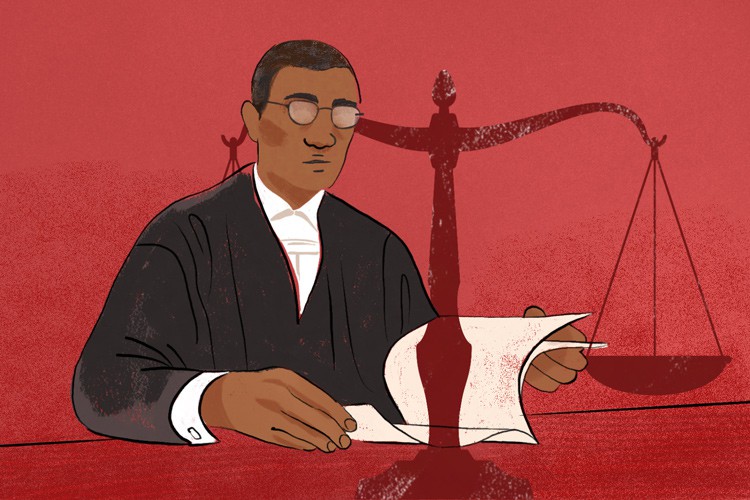
The first of our two readings from Matthew’s gospel reminds us that we all find ourselves wanting to judge other people’s behaviour, but being a judge requires integrity. The recent proposals for more trials being decided by a judge without a jury got me thinking: what qualities do we want in a judge to ensure a fair trial? I would expect them to be [i]
* Qualified to hear the case, with a detailed knowledge of the law;
* Known for their personal integrity with no obvious bias;
* Willing to listen to all witnesses and assess all evidence;
* Be open to ‘mitigating factors’, and set a punishment to fit the crime
We can easily recognise from Becky and Elly’s conversation[ii] that Becky is a poor judge, expecting a higher standard of her son than she has of herself, and not waiting to hear all the evidence before passing judgement. We call such people hypocrites, literally meaning play-actors, or wearing a mask.
Hypocrisy is often unconscious. We do not see the log in our own eyes or realise that we are playing a part to look more holy than we are. We need to learn to recognise this, and admit our own faults and be willing to change to be more like Jesus. Only then should we consider pointing out other people’s faults (as we see them), and even then, be gentle about it, speaking only to encourage change.
Robert Burns put it brilliantly in a well-known verse. (I’ll read it in a contemporary English translation, as I can’t do justice to the Scots original):
Oh, would some Power the gift give to us
To see ourselves as others see us!
It would from many a blunder free us,
And foolish notion:
What pride in dress and act would leave us,
And even devotion! [iii]
Psychologists talk of ‘projection’ – being quick to find fault in others when in fact we are guilty of the same faults. That is what Jesus was getting at with the idea of specks and logs. You may wish to consider: are there any relationships where you are critical of others in areas where you are not faultless yourself? Or where you have not been willing to give someone a second chance?
Second reading Matthew 23:23-26
Our second reading is an extract from a longer passage. It helps if we understand that Pharisees were the more conservative of the two main branches of Judaism in Jesus’ day, and stricter on observance of the ritual law than the minority Sadducees. Jesus was angered by the lack of integrity in the way that they passed Jewish teaching on to young Jews and converts.
I love that image of straining out a gnat (meaning those tiny fruit flies that get in a glass of wine) while swallowing a camel. The point is that both animals were ritually forbidden food, the wine being made unclean if an insect lands in it, but to make a fuss about that while eating camel meat is the ultimate hypocrisy.[iv]
One theme running through the New Testament is that God’s love requires him to show mercy even more than his perfection requires him to judge sin.
The Pharisees, by contrast, were more concerned with judgement than with mercy. We may want to be a ‘Good Christian’ by doing what God requires, but what Jesus is saying here is that principles such as justice, mercy and faith are still more important than specific do’s and don’ts.
Jesus himself was called a ‘teacher from God’[v]. But he emphasised that he was only passing on his Father’s perfect teaching, which is ‘love God, and love your neighbour as yourself’. Love that springs from faith, like God’s. Love that shows mercy, as God does. Love that has a passion for justice, as God has. ‘On these two commandments hang all the law and the prophets’, in other words all those rules about washing cups, giving a tenth of your garden herbs to the church, or taking the fly out of your wine glass because you try to be vegetarian, those all spring from the great principles of love, justice, mercy and faith. And if you can’t work out where those principles are in a particular context, then it probably doesn’t really matter.
These two criticisms of the Pharisees for being more concerned with the tiniest detail of ritual than really showing justice, and wanting to appear perfect on the outside while being imperfect inside, are among seven that Jesus aimed at them. Others were shutting the door of the Kingdom in men’s faces; requiring converts to be even stricter than themselves in observance of the law; taking oaths lightly; being ‘whitewashed tombs’ (another image of hypocrisy), and murdering prophets.
In all this, Jesus’ greatest concern seemed to have been that far from encouraging Jewish people and converts in their faith, the Pharisees were creating barriers that prevented people from entering or growing in it. It is a problem that has recurred throughout Christian history: church leaders who create rules, which may or may not be found in the Bible, to decide who is welcome in their church and who is not.
Where rules are multiplied, or keeping them is seen as more important than having faith, then the Pharisees are back in control.
Let’s take a closer look at the accusation of ‘shutting the door of the Kingdom in men’s faces’[vi]. Julia spoke two weeks ago about the ways in which we can be prejudiced against other people. When Jesus taught about the Kingdom of Heaven, he made a clear distinction between those who are in the Kingdom, and those who are not. But what he did not mean was that we should see ourselves as superior because we identify as citizens of that kingdom, and look down on those who are not.
This can be a temptation for new Christians, where having a rule book to follow seems the simplest way to fit in. The theologian William Barclay said, “A convert often becomes the most fanatical devotee of his new religion”[vii] . But the invitation of Jesus is for anyone, whatever their previous religious or cultural background, to be part of the kingdom, and he often declared people to be in the Kingdom before they had a chance to ‘learn the rules’.
There is a worrying trend of ‘Christian Nationalism’, coming from the USA but now seen in Britain, which takes pride in Christian identity. But it is a very judgemental philosophy, a modern form of Pharisaism, often a smokescreen for prejudice and racist views, not an inclusive Christianity. We must avoid that. If God has made us enthusiastic for our faith, let us encourage it in others. May we be Faith-builders, not Pharisees. Helpers, not hypocrites.
We’ve looked today at what hypocrisy is, and how to be people of integrity in helping others come to faith. If God has pointed out anything in your own life where you could be better in this area, please do ask for prayer after the service. But I will leave the last word, again to William Barclay: “When history judges us, will its verdict be that we were hinderers, or helpers of God? That is a question which every individual must answer.” [viii]
[i] Condensed from part of my blog post ‘Trusting in God’s Judgement’ (7 December 2025).
[ii] The sermon was delivered in two parts, with a short sketch between the Bible reading and commentary in each part. The sketches illustrated how two friends react differently to events in their lives.
[iii] https://en.wikipedia.org/wiki/To_a_Louse (with slight adaptation)
[iv] Leviticus chapter 11 (camels v.4, insects v.23 & 34)
[v] John 3:2
[vi] Matthew 23:13
[vii] ‘The Daily Study Bible: Matthew Volume 2’, Saint Andrew Press 1975, p. 290
[viii] Ibid, p.298.