
Common Ground song 135 ‘The seed is Christ’s’
Words: James Quinn (from the Gaelic) © Geoffrey Chapman / Music: Sean O’Riada © Richard MacGovrain
YouTube video: https://www.youtube.com/watch?v=4Bm33Nn5tFM
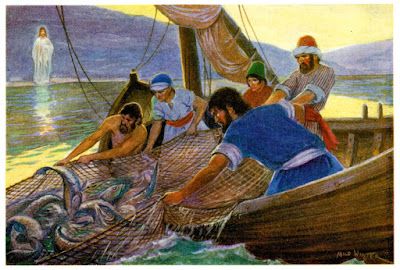
Featured image: Jesus calling his disciples to fish for people. From sersaldelatierra.blogspot.com (original artist unknown)
The fourth and last of a set of posts on harvest songs. This one is least directly related to the traditional idea of harvest festival as celebrating the ingathering of crops, and much more about the ‘harvest of souls’. The words of the song are translated from a traditional Irish poem, ‘Ag Críost an síol, ag Críost an fómhar’. Two different translations are given here, one of which is used in the linked YouTube video. It is a short song, but the more I ponder on it, the stranger the imagery seems. Please read on…
The first half of the through-composed song compares Christ’s harvest of souls to the ingathering of crops on land and fish from the sea. Just as people gather crops to nourish our bodies, so Christ gathers our souls (willingly, of course: he uses no compulsion, only love) to be part of his Kingdom. ‘Into God’s barns / Into God’s nets, may we all be brought’.
There is a darker side to some of this harvest imagery. When Jesus told his disciples that he would train them to be ‘fishers of men’, he was using imagery from their own trade. They knew that people don’t usually catch fish to put them in an aquarium where they can be admired. Mostly, they are caught for food, and don’t live long out of water. What does that say about us when we are ‘caught’ for Jesus? We no longer live for ourselves, but part of us dies to self so that others may be spiritually fed, perhaps. I’m sure other interpretations are possible, and the miracles of feeding the crowds with bread and fish may point in the same direction.
The second half considers the path of our lives: ‘From birth to age, from age to death’ and ‘until … the great rebirth’, we ask to be enfolded in His arms in this life and for Christ to ‘be our joy in Paradise’. In a Christian worldview, earth and heaven, life and death are not two completely separate realms, but we move from one to the other. During our earthly life living more and more as ‘citizens of heaven’ (Philippians 1:27), so that when our bodies fail, our souls are prepared for that final transition. If we have been caught up in God’s net or his barn, the selfish part of us has already died, and we become not only partakers of the heavenly banquet, but also part of the food on offer. One of the many aspects of the mystery of the Eucharist may lie somewhere here.