
Sermon for 26 July 2026, St Peter’s Bramley. Based on Psalm 40.
A soundtrack for life
We have called this sermon series ‘Summer Soundtracks’, because the psalms are often sung, and the words stay with us like a playlist on a phone. Sometimes, it’s the music as well. This week I mentioned to my Mum that I would be speaking on Psalm 40. “How does that go?” she asked, and I read the first few verses to her. Then she remembered something from more than seventy years ago and started singing. I recognised the tune: Mendelssohn. A quick internet search, a YouTube result, and she was listening to the anthem in which she had sung a solo as a music student in the 1950s. Truly a soundtrack for life.
BLACK: The problems and stresses of life
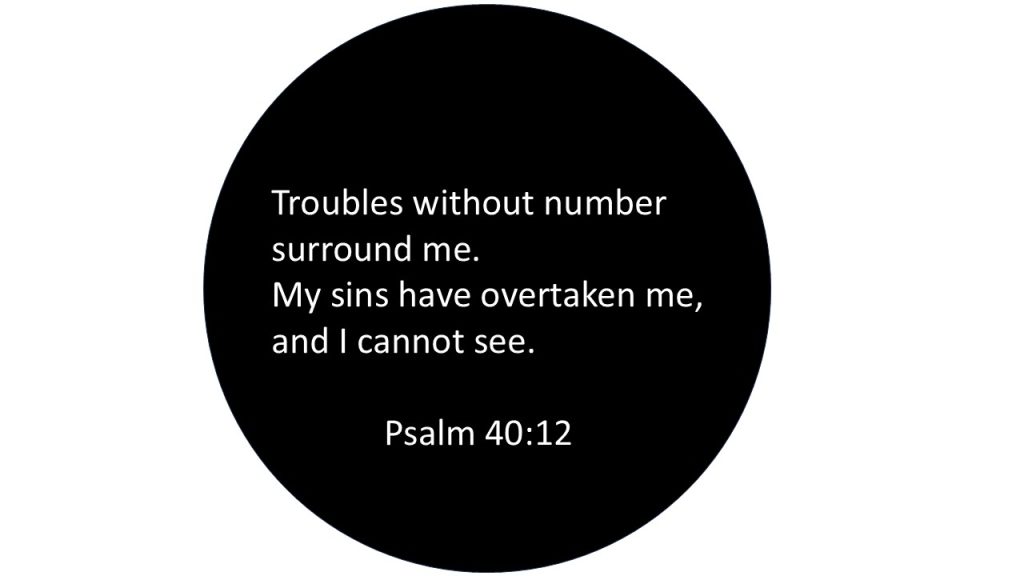
We often need to have those words and songs to fall back on. Because life is hard, isn’t it? We have unexpected problems; we have stresses of home life and work to cope with. There are disappointments and failures, people treat us badly. Whatever. It was ever so. Look at verse 12. “For troubles without number surround me; my sins have overtaken me, and I cannot see. They are more than the hairs of my head, and my heart fails within me. Be pleased to save me, LORD; come quickly, LORD, to help me.”
I want to look at what this psalm tells us about how we can react to those “troubles without number” in our life. I’m going to use colours to help us think about that. Black is universally the colour of trouble, stress or depression. What might other colours suggest to us?
GREEN: Waiting on God

Green is the colour of calm. Think of sitting in a green field, surrounded by green trees, and relaxing. The opening verse of the psalm tells us what to do when we are stressed. Most translations of the psalm use this phrase, “I waited patiently for the LORD; he turned to me and heard my cry.” But it is worth looking at alternatives.
The Jerusalem Bible, always good for the more poetic parts of Scripture, renders it as ‘I waited and waited for Yahweh, now at last he has stooped to me and heard my cry for help’. This carries a stronger sense of persistence in prayer, and of God actively moving in our direction in response. The Latin title for the psalm, still found in some English translations and choral settings, is ‘Expectans expectavi Dominum’. I like that. ‘Expectantly, I expected the Lord’.
I am not just praying in a vague hope that he might, eventually, hear me. No, I am expecting that he will hear me, and that creates in me a sense of anticipation. Prayer, or sung worship, should start with that attitude: I expect a response from God. Waiting patiently makes us receptive to hear his response. Verse 6, “my ears you have opened”. And that response is one of practical help. Verse 2, “He lifted me out of the slimy pit, out of the mud and mire; he set my feet on a rock and gave me a firm place to stand.” We opened our worship today with that song – ‘Build your house on the Rock’. When life hits hard, then, we wait expectantly on God, to listen for his coming to help us and set us on that rock of faith.
RED: Worship in the congregation
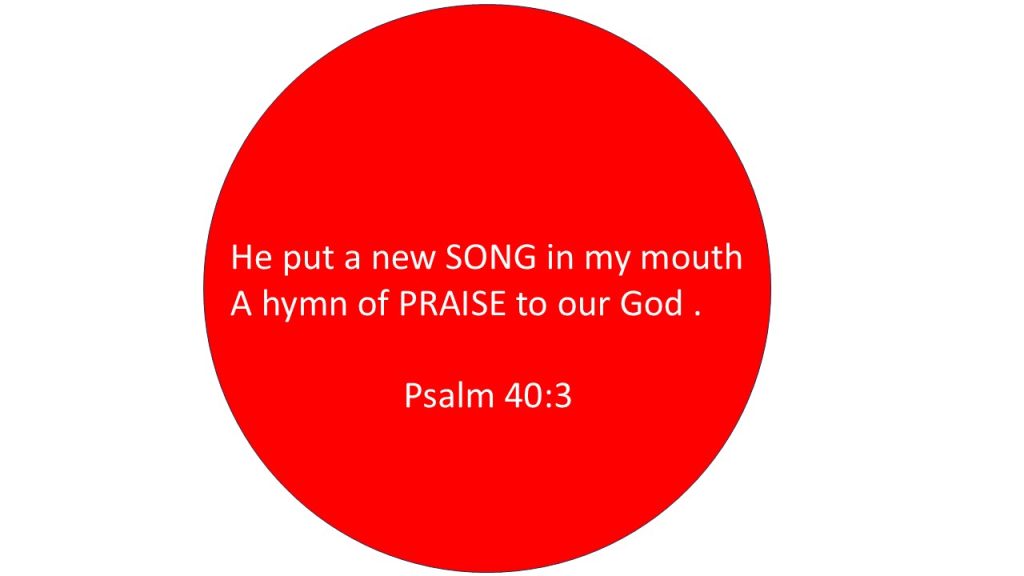
Red is the colour of excitement, often associated with the Holy Spirit. Verse 3: “He put a new song in my mouth, a hymn of praise to our God.” It is now widely accepted medically that singing, especially group singing, can help promote mental wellbeing and generate a positive mood. When we experience difficulties in life, that is not the time to give up coming to church. Quite the opposite: joining in worship will help to put our individual troubles in perspective, and singing will truly boost our mood.
But beyond that secular observation, singing worship songs to God also brings us closer to him, by aligning our desires with his. Verse 9: “I proclaim your saving acts in the great assembly; I do not seal my lips, LORD, as you know.”
There is another benefit when we come to church in these circumstances. We can safely share our troubles with other people here. ‘A trouble shared is a trouble halved’. And there is more. If in our waiting on God, we have heard him answer us or received his help, share that with other believers for their encouragement. Verse 10: “I do not hide your righteousness in my heart; I speak of your faithfulness and your saving help. I do not conceal your love and your faithfulness from the great assembly.”
By sharing with other people what God has done for us in Jesus, we witness for him. The second half of verse 3: “Many will see and fear the LORD and put their trust in him.”
BLUE: God’s will be done

Blue is the colour of the intellect, as in ‘blue sky thinking’. Once we have waited on God, expected him, heard his response to our cry, and come into the assembly of the faithful to witness to that and to sing his praise, what then? Verse 8: “I desire to do your will, my God; your law is within my heart.”
Adrian spoke last week about the importance of getting to know the Bible. Because that is how God usually guides us to do his will. Of course, many people will testify that they have heard God directing them to do something on specific occasions. But most of the time, for most of us, ‘Doing God’s will’ is much the same thing as ‘having his law in our heart’. By memorising key verses, or at least knowing which book of the Bible they come from, and understanding the overall principles of Christian teaching based on the New Testament, we have it ‘in our hearts’ what is the right thing to do in most circumstances.
A good driver will have studied the Highway Code to inform their driving skills. You don’t have to be able to quote which rule says you must not overtake near a pedestrian crossing (I did look it up – it’s Rule 167) but you know from your experience as well as reading that it’s not a safe thing to do. So, with us, we don’t have to be able to quote chapter and verse, but we should at least know what reliable Christian teaching based on the Bible would expect us to do in any normal situation.
THREE COLOURS: Chapters in a story
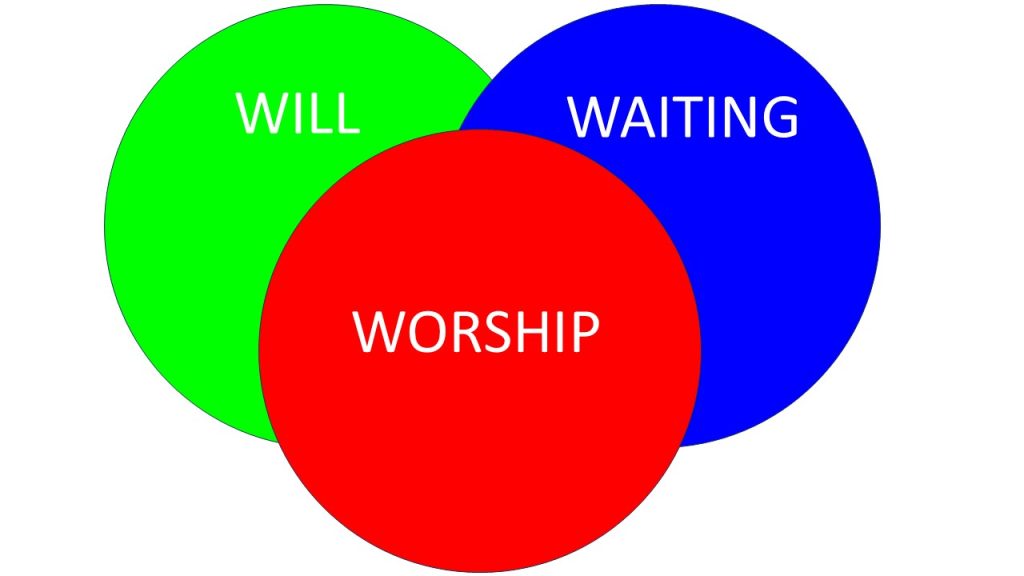
These various verses of the psalm make a consistent story arc. The psalmist waits expectantly for God to hear their prayer. God listens, raises them from the (literal or metaphorical) pit into which they have fallen, and sets them on a rock. In return they can sing God’s praise, so that other people will in turn trust in God. Finally, the person who started off not in control of their life will find themselves in the totally different position of God being in control of their life, so they can do his will. Waiting, Worship and Will: three chapters in a story, and three colours of our emotions.
WHITE: A balanced Christian life
The Psalm finishes with thanking God for all his goodness. Verse 16: But may all who seek you rejoice and be glad in you; may those who long for your saving help always say, “The LORD is great!”
When you were at school you probably saw a demonstration using coloured lamps of how the three primary colours of green, red and blue combine to make the purest white. In the same way, these three actions of calm waiting, joyful praise, and careful study of the Bible, can combine to produce the sort of purity of living that God seeks. Our Gospel reading hints at the same sort of thing: “I have come into the world as a light, so that no one who believes in me should stay in darkness.” [John 12:46]
This is the essence of our relationship with God: whenever we are in any kind of trouble or distress, we can ask him to help and he will help, in some way. But expects us to thank and praise him, tell other people of what he has done, and accept his teaching to help us deal with it.
So, there you have the latest addition to our summer playlist. Whether you prefer Felix Mendelssohn’s choral version, or John Bell’s more recent and simpler setting, Psalm 40 will get your emotional colour palette suitably blended to produce a right, white way of living. Amen.
Cover image: Copyright Colin Park cc-by-sa-2.0
One thought on “Living in the Light”