
Common Ground Song 4 ‘All are Welcome’
Words / Music: Marty Haugen © GIA Publications Ltd
YouTube recording: https://www.youtube.com/watch?v=mTdxFRfEoMs
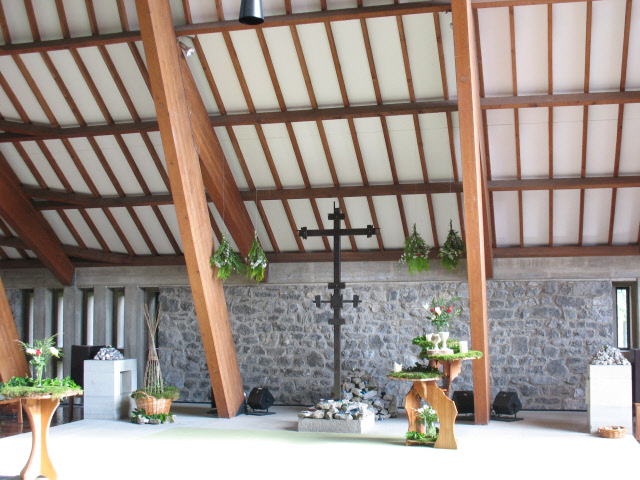
Featured image: Scargill Chapel © Stephen Craven
This hymn by American composer Marty Haugen bridges the dual understanding of the word ‘Church’. To many people (whether practising Christians or not) the word refers mainly to a building. To other people, it means a congregation or a network of similarly-minded congregations. Of course, it covers both. In the hymn, the church building is called a ‘house’, which is a good usage because for many of us it is indeed our ‘second home’, the place where we meet our friends as well as God.
Verse 1 defines this ‘house’ as a place where people learn to forgive each other and end division in Christ’s love. Many people find that when they become part of a stable church congregation, they find the courage to open up their true identity and trust others for the first time. It also defines the buildings as ‘built of hopes and dreams and visions, rock of faith and vault of grace’. These intangible qualities take on a new reality and significance when we are part of such a congregation.
Verse 2 speaks of the activities that take place there: prophecy, preaching and faith. A well-designed church building will meet the needs of its congregation, whether for worship or any other kind of meeting, and as a base for outreach into the local community. An architecturally pleasing building will also attract attention as part of the streetscape, and one that has a welcoming approach and entrance will draw people in. The verse also speaks of the cross ‘as witness and symbol of God’s grace’. A church, especially a modern one that might look like any other community building, is often easily identified by the universally recognised symbol of the cross.
Verse 3 refers to the uniquely Christian act of Holy Communion (‘water, wine and wheat’). It makes the building a spiritual ‘banquet hall on holy ground’. But as Communion normally only involves a token amount of food, we also need to eat properly together. So, a church will also usually have a kitchen. Along with that go other utility rooms: storage facilities, toilets and so on.
Verse 4 speaks of the ‘wood and stone’ of which the church is built: traditional building materials, though modern ones may use brick, concrete and steel. But to many Christians the church building should also be in itself an act of worship, a response to our faith in God who created a beautiful world, who came in the form of Jesus to live in it, and who through his Spirit gives gifts of creativity. Which is why many church buildings, old and new, contain some of the greatest art works in statuary, stained glass, wall paintings and so on. I always associate the hymn with the place I first sang it, Scargill chapel, a beautiful grade II* listed place of worship for the resident community and guests, designed by George Pace in local limestone and laminated timber. Hence the featured photo. But the words urge is to think ‘beyond the wood and stone’ to serve our local community, and welcome them in, ‘outcast and stranger’.
The final verse speaks of how belonging to the church community allows us to be truly ourselves: to be ‘named and heard, loved and treasured, taught and claimed’. The Church, we sing, is ‘built of tears and cries and laughter, prayers of faith and songs of grace’.