
Common ground Song 85 ‘May your love be upon us’
Words: © Michael Lloyd / Music: © Panel on Worship
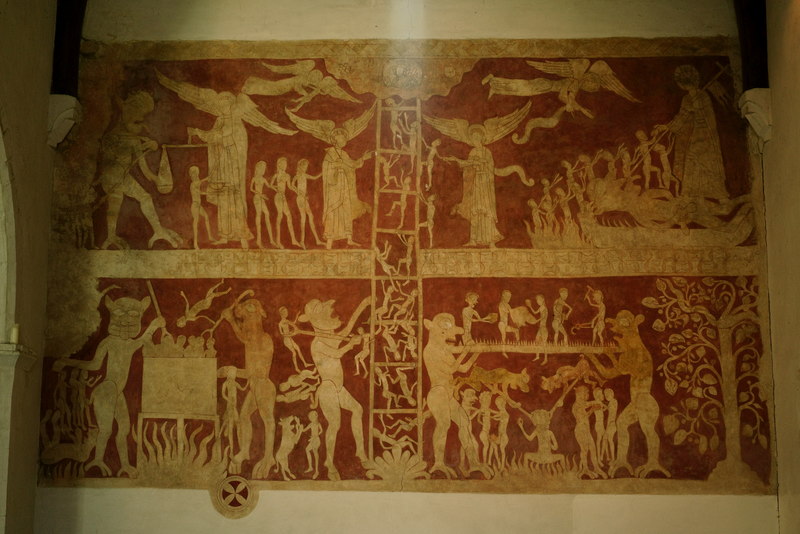
Featured image: Medieval doom painting, St Peter & St Paul, Chaldon (Surrey). Image © Peter Trimming cc-by-sa-2.0
This is a setting of Psalm 33 to a variation on a Scottish folk tune ‘Leezie Lindsay’. I was unable to find a recording of it online, although other, similar paraphrases of the same psalm are available. It has three verses, and what is called an ‘antiphon’ rather than a ‘chorus’. That usually means it is intended that a solo cantor sings the verses, the whole congregation responding each time with the antiphon. This is a common way of singing the psalms in Catholic churches.
The word linking all three verses and the antiphon is ‘love’. What exactly is God’s love, and what does it do? ‘Love’ in the Bible, especially God’s love, is never just a feeling. It is always about serving other people. In verse 1, his love is combined with his ‘faithful word’ and his ‘true works’. The effect of these three (love, word and works) is to ‘renew the face of the earth’. So it is with us as his people: we are to love the earth and its people, speak words of healing and work for its restoration.
In verse 2, his love is said to ‘rescue souls from damnation, from famine, from death’. In verse 3, that idea is followed up, as we ask that God’s love be upon us as our souls wait ‘for my Lord, my sword and my shield’.
The idea of a soul needing to be saved from damnation is not one often spoken of in churches today. As mentioned in recent posts, my wife Linda died recently, and I have been reading a textbook on bereavement (1) in which the author notes that a medieval preoccupation with the fate of the soul was replaced from the Reformation onwards with a concern for a decent burial of the body, and in the last hundred years with more of a concern for the welfare of the bereaved family. But it has always been at the core of Christian belief that Jesus’ death and resurrection ensure the eternal safety of the souls of those who believe in him.
(1) Walter, T: ‘On bereavement: The culture of grief’, Open University Press, 1999