
Common Ground Song 49 ‘Heaven shall not wait’
Words / Music: John Bell & Graham Maule © WGRG / Iona Community
YouTube recording: https://www.youtube.com/watch?v=VOHOmQ9LU1M
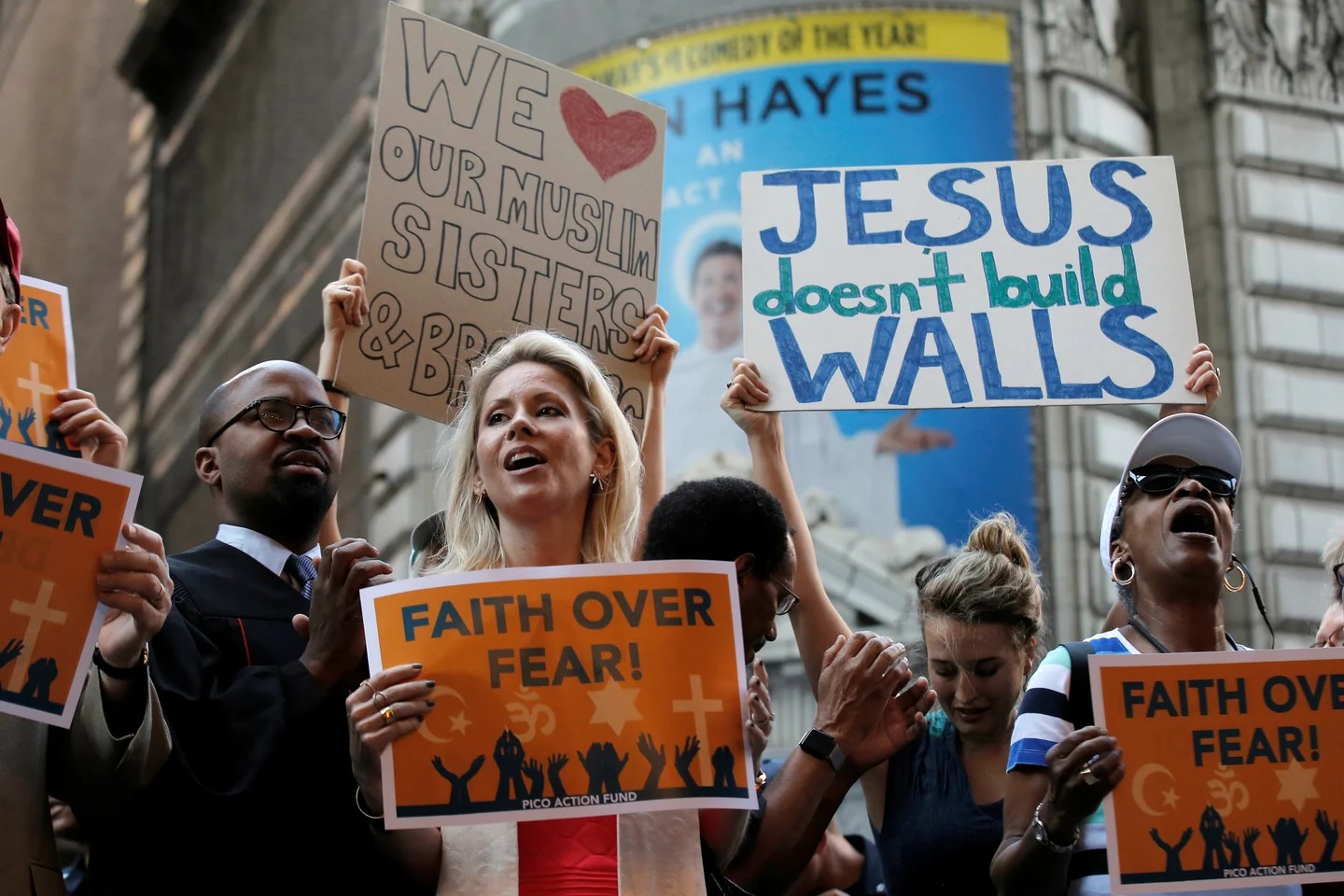
Featured image: Interfaith protest in New York City, June 21, 2016. © Brendan McDermid / Reuters
Another of John Bell and Graham Maule’s collaborations, this is a song with a difference. It is neither a hymn in the traditional sense of singing praise to God (written in second-person language), nor a worship song expressing the singer’s lover for God or Jesus (written in the first person). It is third-person writing, consisting of a series of statements. Take away the music and read it as prose.
It is clearly, then, a call to protest. The first lines of each of the four verses are exactly the sort of wording you might see on a hand-painted banner on a protest march. The protest is against all the injustices in the world: war, poverty, hatred, pride, accumulated wealth, elitism. There are, of course, many people across the world actively protesting such things. On marches, in universities,on social media, to their local councillors and state representatives. Some even go to prison or worse for their ‘crimes’.
Many Christians and other people of faith are among them, because those who believe in a God of love, justice and mercy (be they Jew, Christian, Sikh or Muslim) desperately want to see unjust structures changed. That is why each verse begins ‘Heaven shall not wait…’. ‘Heaven’ in this sense meaning not the afterlife, but what Jesus called the Kingdom of God, the way of right living that he came to establish.
But we have to be realistic. Despotic empires are not brought down overnight: take out one regime leader and another will take his place, as the USA has recently learned yet again in Iran. Economic structures take decades to change: a well-meaning political candidate may be honest in their promises to set things right, but when in power they find it ain’t so easy. Human hearts and attitudes also take generations to change.
So what do we do in the meantime, while protests fall on deaf ears? The answer, according to these lyrics, is to “Think global but act local”, a phrase that has been around in protesters’ circles for decades. There are several people credited with its origin, but it is now a well-established principle.
The second half of each verse begins with the Christian’s reason for acting locally while thinking globally: ‘Jesus is Lord’. At the global scale, we believe that with Jesus as Lord in Heaven, prayer does change things in ways we cannot understand. But we also remember the ways he acted locally in Galilee and Judea, healing the sick, comforting the bereaved, challenging prejudice, overturning the tables of unscrupulous traders. ‘Direct action’ is as much a Christian imperative as are prayer and political involvement.
The attitude with which we do this is equally important. Jesus has, in these words, ‘shown the master’s privilege: to kneel and was servants’ feet’. We act not as ‘do-gooders’ but in humility as servants of the Servant King.
Different people, with different gifting, will be called to different forms of service. For some, their position in society and level of education will make them the right people to act at a national or global level in organising a large-scale response to injustice, perhaps by founding a charity or fundraising for a cause. Others will be able to use skills in medical or social care to work one-to-one with people in their local area. And others, perhaps of a more reflective and pastoral personality, will simply sit with those who suffer and mourn with those who mourn, as Jesus also did. What matters is to hear the clarion call and act on it: ‘Heaven shall not wait’.