
Common Ground Song 142 ‘’When, in our music, God is glorified’
Words Fred Pratt Green © Stainer & Bell Ltd / Music: Marty Haugen © GIA Publications Inc
YouTube recording: https://www.youtube.com/watch?v=bzclcCg9NmI
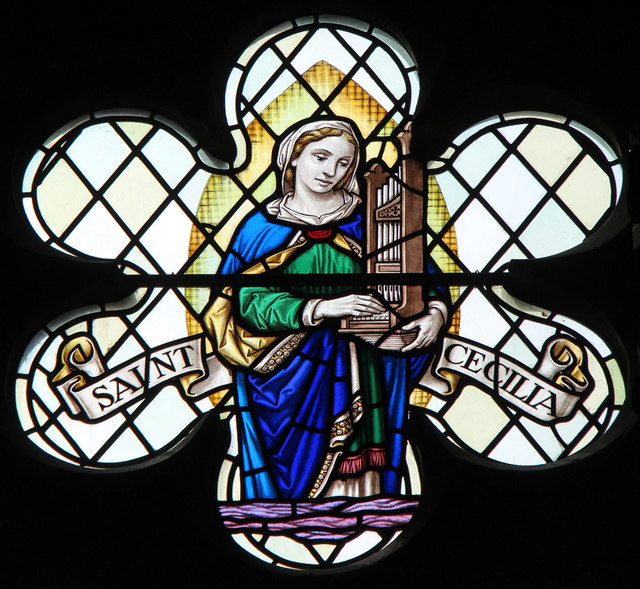
Featured image: Stained glass window of St Cecilia, patron saint of church music.
Christ Church, North Finchley. © John Salmon cc-by-sa-2.0
First, to avoid confusion: there is a hymn of the same name by the late Victorian / Edwardian composer Charles Villers Stanford. And these different words by Fred Pratt Green are normally sung to the tune ‘Engelberg’. Nearly all the recordings on YouTube are one or other of those. The one I found to Marty Haugen’s arrangement does not have the words, but they can be viewed online here.
With few exceptions, music has always been essential to Christian worship, as it is to our Jewish brothers and sisters. The Psalms constantly encourage us to praise God, and examples are found throughout the Bible of people doing just that. St Paul exhorted his hearers to sing ‘psalms, hymns and spiritual songs’, that is both pre-composed pieces for congregational singing, and also whatever music and words the Holy Spirit gives us with which to express our personal devotion.
The words of Pratt Green’s hymn make some valid points: ‘adoration leaves no room for pride’ reminds us that our music-making should always be to build up our own and other people’s relationship with God, and never a ‘performance’. ‘Worship moved us to a more profound Alleluia’ emphasises the power of music t stir up a true sense of praise.
The reference to the Church ‘bearing witness to the truth’ through the centuries refers to the value of hymns being passed from one generation to another as tradition, in the same way as the teaching of famous theologians. This is something that we risk losing in the age of digital projection, when the best of contemporary worship does not end up in a hymn book on the shelf or in the library for later generations to rediscover.
The fourth verse reminds us that Jesus and his disciples sang a psalm (‘hymn’ in many translations, but probably a psalm arrangement) before he went to Gethsemane and to death. The courage to sing God’s praise in the face of suffering is a mark of true faith.
Each verse ends with a threefold ‘Alleluia’, the Hebrew or Aramaic word that has come down to us unchanged as a shorthand way of expressing praise to God, shared by people of faith whatever our first language.