
Sunday 13 September. Song 78 ‘Lord, we come to ask your healing’
Words: Jean Holloway © Kevin Mayhew Ltd / Music: traditional
YouTube video: https://www.youtube.com/watch?v=1NMxH0fdcGg
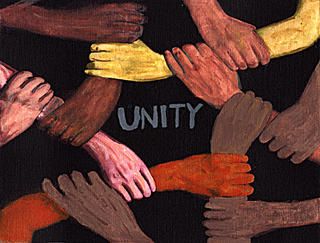
Featured image: ‘Unity 1’ from stevenjcamp.blogspot.com, originator unknown
From the title of this hymn, you might think it is about the ‘healing ministry’, usually understood either as specific prayers for individuals to be healed of particular diseases or injuries, or more generally praying for people to live lives free of any form of suffering.
It is, but only partly so. The theme of the hymn is actually love. A word that appears at the end of three of the four lines of every verse. The lyrics explore a wide range of understanding of what love looks like in practice, with particular reference to a church congregation.
The first verse does indeed ask for healing, but in this case we are asking for the Church to be healed of the things that harm her unity: shame, selfishness, ‘feuds and factions’. It can sometimes take much longer for someone to understand the harm that this sor of behaviour causes, than for them to accept the Gospel message of individual salvation. Moving from ‘I am saved from sin’ to ‘We are brought together by Christ to work together in his Kingdom’ is almost a second conversion. For that reason we pray, ‘Teach us of love’.
The second verse is more about the individual’s relationship with Christ. His loving nature can indeed ‘Soothe away our pain and sorrow’ and deal with the ‘dark, danger and dread of tomorrow’ that some people face continually and most of us will face from time to time. Again, accepting this requires a move on from ‘Christ died to save me from sin’ to ‘Christ is risen to show me his love’. For that reason we pray, ‘Hold us in love’.
The third verse, provided as an optional one for a Mass or Communion service, refers to the sacrament as a sign of that divine love. We ask that our faith be made ‘more than just an empty token’. Once again, moving on from a simplistic view of salvation to one in which the love shown in Christ’s dying and living sends us out to live for him. For that reason we pray, ‘Fill us with love’.
The final verse builds on that. We ask Christ to ‘help us live for one another as equals, whether stranger, neighbour or family. ‘All are equal at your table’ must be more than a mission statement, but a practical way of living together. For that reason we pray, ‘Bind us in love’.
Taught of love, held in love, filled with love, bound in love. That is what a church should be. ‘Healed’ in the ancient sense of ‘made whole’. Brought together with our differences and sent out, maybe fed with the Eucharistic bread, as one body.