
Common Ground Song 138 ‘We cannot measure how you heal’
Words: John Bell & Graham Maule / Music: Trad., arr. John Bell © WGRG / Iona Community
YouTube video: https://www.youtube.com/watch?v=OrNoQisGbDw
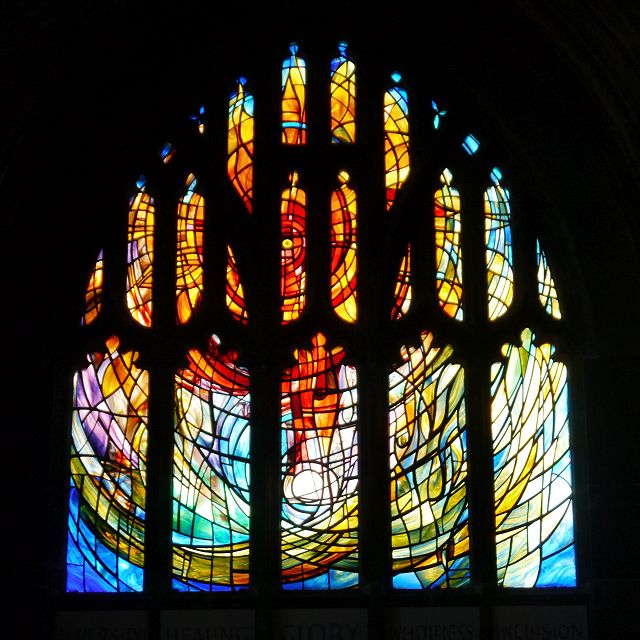
Featured image: Healing window, Manchester Cathedral © David Dixon / cc-by-sa-2.0
The notes below, apart from references in italics to Linda, are mostly copied from 11 August 2021, when I commented on the same hymn in the ‘Sing Praise’ book. Those 2021 posts are no longer online due to a change of blog host.
The whole area of spiritual healing is one in which attitudes vary among Christians, from those who dismiss the idea that God can intervene at all in natural processes to those who believe that any physical or mental illness can be healed with prayer if only we have enough faith. But most of us, I hope, would accept that God can and does heal, and that an apparent lack of healing in response to prayer is not the fault either of the sufferer or the one who prays for them.
That seems to be the starting point of this hymn: we cannot understand the “how” or “why” of healing, yet “we believe your grace responds where faith and doubt unite to care”. The second part of this first verse refers to Jesus’ blood on the cross, which is an essential part of a specifically Christian attitude to healing: Jesus suffered both physical and mental pain, to an extent that few humans are unlucky enough to share, and only the truly evil would wish on anyone else. The one line in the hymn not referenced in my 2021 commentary, that has now taken on a significance to me, occurs near the end of this verse: ‘to carry all through death to life’. The ultimate healing, for us as Christians, is in fact death, which is but the gateway to a timeless existence with God and all who have trusted in Christ This life will be free from pain, guilt, unforgiveness or anything else that has made our earthly life difficult.
The second verse acknowledges what is increasingly understood by medical practitioners as well as faith healers, that good health and effective healing are heavily dependent on psychology and on a person’s past experience. Pain, guilt, fear and bad memories are indeed “present as if meant to last”, preventing us from achieving health in the roundest sense of that term. The antidote to that is explained here as “love which tends the hurt we never hoped to find”. The third verse also makes reference in the phrase “some have come to make amends” to the fact that lack of forgiveness, either for our own sins or for the ways that others have hurt us, can also lead to ill health and prevent healing. Without going into detail, I believe my late wife Linda held onto some past hurts which may have contributed to her many physical health problems.
Many people have testified to the healing work of God’s Holy Spirit in uncovering past experiences that are at the root of later suffering. I would refer you to “A smile on the face of God”, by Adrian Plass, a biography of the Revd Philip Ilott who experienced this as part of his own healing as well as being given the spiritual gift of bringing God’s healing to others. The process was not a pleasant experience for him, and his story is certainly not one of ‘happy ever after’ (in fact he died of multiple sclerosis) but it does illustrate many of the points made above, and along the way he discovered the peace of God that can be present even though pain, which sometimes is in fact the healing that is needed.