
Common Ground Song 115 ‘Some hae Meat’
Words: Robert Burns / Music: © Ronald Dellow
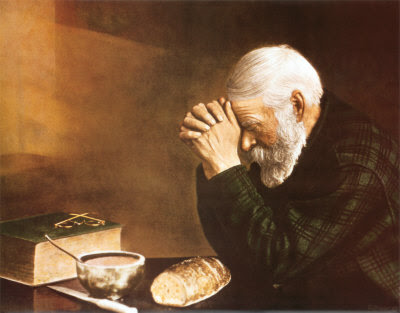
Featured image: Man saying grace. From a Spanish language blog ‘rara avis’, original artist unknown.
Here we are in the first week of October. As with many British churches, ours had its Harvest Festival today. This week I will comment on the four harvest-themed songs in Common Ground, leading up to my sermon next Sunday on being fruitful in our lives.
The words to this first one are those of what is generally called the ‘Selkirk Grace’, often attributed (possibly wrongly) to Scotland’s national treasure Robert Burns. It would usually be spoken rather than sung, and the arrangement here in a four-part round is by a rather obscure New Zealand songwriter, so I was unable to find a performance of it online. So let’s just treat it as a prayer.
Some hae meat that cannae eat,
and some wad eat that want it.
But we hae meat and we can eat,
Sae let the Lord be thankit.
‘Meat’ here is used in its older sense of any food, not just animal flesh, and the dialect is that of southern Scotland in the 18th century. A contemporary version might therefore be:
Some have food but cannot eat
what some can not afford.
But we have meals that we can eat,
so let us thank the Lord.
There is an important principle here, that most churches celebrating Harvest do try to bring out in their worship and teaching. Which is that both need and supply are unfairly distributed, both locally and globally. Locally, some people (myself included) are fortunate to have good health and appetite, and enough money not to have to worry about paying for food (as long as ‘eating out’ is an occasional treat, not a daily luxury). Many people, though, cannot afford adequate food, or struggle to balance paying for food, rent, heating and other essential costs. We respond to that locally by supporting the foodbank and signposting people to where they can get help with finances. And there will indeed be some who could afford to eat well but whose medical or psychological conditions restrict what type or quantity of food they can manage.
Globally, it has often been said that innovations in farming in recent decades mean there is still enough land to grow food for the world’s nearly 8 billion people. However, we need to use the land more wisely by eating mostly plant-based foods directly rather than growing crops to feed animals that take up a lot more land. And world economics needs to address the scandalous inequality in income between the richest and poorest countries.
While these are long-term problems, Christ always invites us to walk with him bay by day, asking for, and being thankful for, our ‘daily bread’, always being mindful of those who lack it. So let us say again that prayer, perhaps in Burns’ original version: let the Lord be thankit!