
Saturday 18 July. Song 15 ‘Blest be the Lord’
Words: © 1991, Owen Alstott. based on Luke 1:68–79 / Music: © 1993, Bernadette Farrell. Text and music published by OCP. All rights reserved.
YouTube recording: https://www.youtube.com/watch?v=-cH8I4y89n0
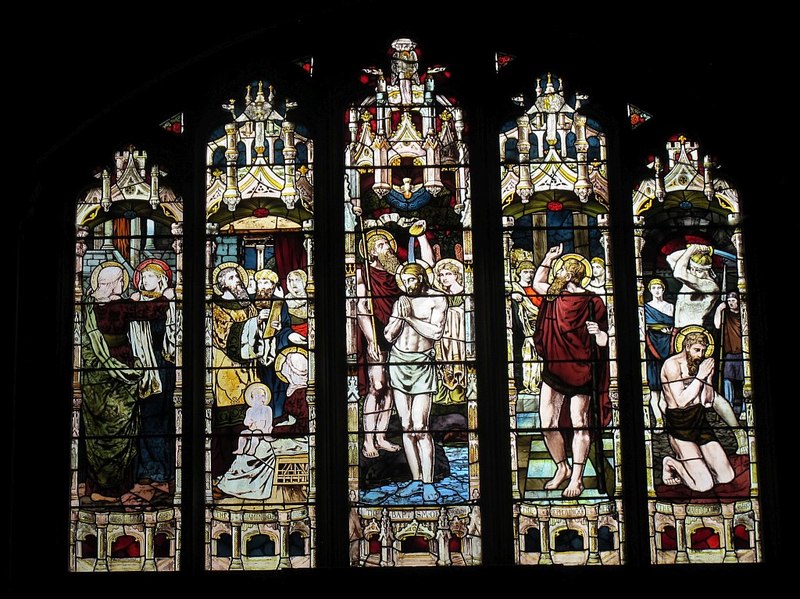
Featured image: St John the Baptist, Low Bentham: east window © Stephen Craven. The window depicts the life and bloody death of the church's patron saint.
What we have here is not so much a hymn as a canticle. What’s the difference? A canticle is (usually) a setting of words from the Bible sung as part of a church service, often but not always from the Psalms. In this instance, the setting is of two very well known texts from Luke’s gospel: Benedictus (Blest be the Lord) also known as the Song of Simeon, and Magnificat (My soul proclaims the greatness of the Lord) also known as the Song of Mary. The two are not expected to be sung together, rather, Benedictus is traditionally sung at Morning Prayer, and Magnificat at Evening Prayer. But a common musical setting is provided for the two.
The words of a canticle are typically a paraphrase rather than a literal translation of the original, in order to fit a particular tune. The term ‘canticle’ implies chanting rather than singing. This particular setting sits somewhere between a traditional hymn (which would be set to a strict time signature such as 4:4 or 6:8) and a true chant, where a fixed set of notes will have their length adjusted to fit the number of syllables required. So we end up with five stanzas using the same tune (like a hymn) but with a time signature that varies(£:2, 2:2 and 4:2).
The context of Benedictus is the prophecy that the priest Zechariah received that his son (later to be known as John the Baptist) would be the herald of the coming Messiah. The canticle is Zechariah’s response, on the day that John was circumcised. The words of the first part are nationalistic in their vision: God has raised up a king descended from the great David (meaning Jesus of Nazareth, though he is not named in the canticle), who would rescue the nation of Israel from their enemies, according to the promise made many generations before to Abraham.. At that time his hearers would have assumed this meant freeing them from Greek and Roman rule. This sense of the tribes of Israel being God’s chosen people and entitled to his protection might be seen even down to our own time in international relations (but this is not the place to enter into discussion about that). But that is not the sort of king that Jesus would be.
The second part of the canticle focuses on the calling of John. He would be called ‘Prophet of the Most High’, and his followers came to recognise him as the first true prophet of Israel for several hundred years. He would not, himself, be the Saviour (the Messiah) but would prepare the way for him. How? Through the forgiveness of sins. His task was to call people to holiness and repentance, to open their minds and hearts to be ready for the radical teachings of Jesus who would follow immediately on from him. Just as the great prophet Elijah was followed by his disciple Elisha who in many ways was an even greater prophet, so John would be followed by his disciple Jesus who would be even greater. In Zechariah’s prophetic words, Jesus would ‘give light to those who live in darkness and the shadow of death, and guide our feet into the way of peace’ (Luke 1:79, JB). And eventually, dying so that we all have the offer of eternal life. Those are the enemies from which Jesus frees us: not Greeks and Romans (or even Palestinians and Iranians) but sin, despair and ultimately death.