
Sermon for St Peter’s Bramley, Sunday 15 June 2025
Readings: Mark 1:9-11 & Hebrews 10:19-23
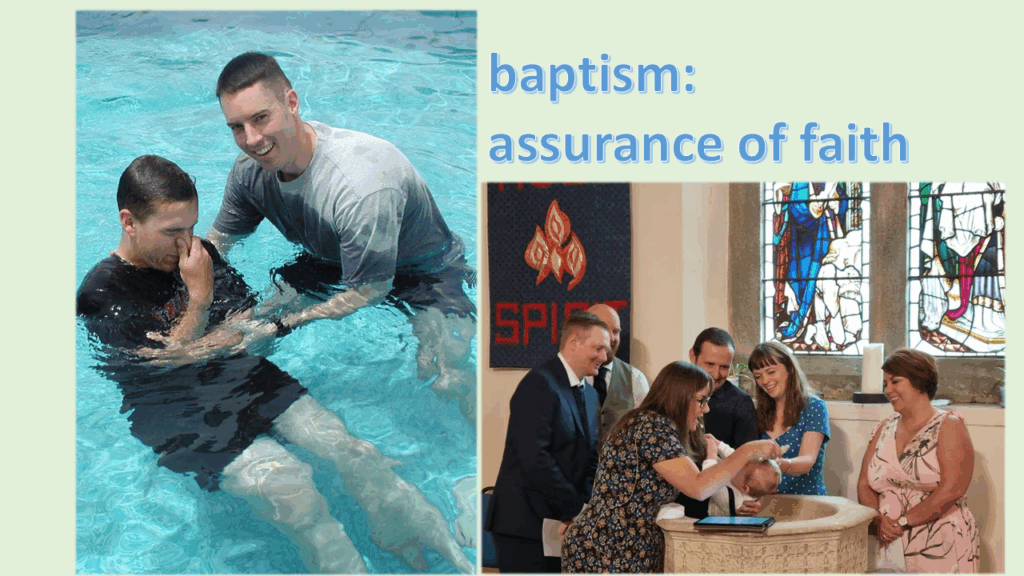
The Bible reading we had from the letter to the Hebrews tells us how we should approach God: “with a true heart, in full assurance of faith, our hearts sprinkled clean, and our bodies washed with pure water”.[i] The reference to washing bodies means baptism, in this context. Baptism of adults is often by immersing the whole body in water, as Jesus was at his baptism, to show that our sins are forgiven and our hearts made clean. For younger children, we usually just pour water over them instead. But the phrase that I want to focus on today is in the first part of the verse: “in full assurance of faith”. That’s the attitude in which we come to baptism: feeling assured.

Let’s think about that word ‘assurance’, because it’s something that we all need. Now there is a subtle but important difference between the two words assurance and reassurance. Reassurance is saying what we think someone needs to hear. Right through our lives, we need to seek reassurance from others, but it is especially so of children. Consider whether you ever asked any of these questions as a child: “Will I pass the exam?” “Do I look pretty in this?” “I will get better, won’t I?” Or that favourite of children on the move: “Are we nearly there yet?” You may have been worried about what was going to happen, and you needed to hear someone else encourage you to be confident. And the adult, if they had any sense about them, would have recognised the question for what it was, and given as much reassurance as they could without actually telling a lie!

Assurance, on the other hand, is telling someone something that is true or certain, by way of motivation. Let me illustrate the difference: if you ask a friend whether you can get by train to – let’s say – Thurso and Ullapool in the north of Scotland, they may well say “I’m sure you can”. That is intended to be reassurance. But if you come to me as someone who knows a thing or two about railways, I can assure you that you can get to Thurso, because I have done it myself, but I can also assure you that there has never been a railway to Ullapool. As shown on this map for evidence.
To a young child, there may be no difference between the two. What an adult says must be so. But when a young person reaches adolescence, he or she begins to realise that what adults say isn’t always completely and literally true, for many reasons. What he or she needs is then not so much reassurance as true assurance – to discover what really matters, what life is really about, which things are true. God, as the ultimate parent, the one who created us and loves us, is always ready to offer that sort of assurance to his children. And it is in baptism that we find signs of that assurance.
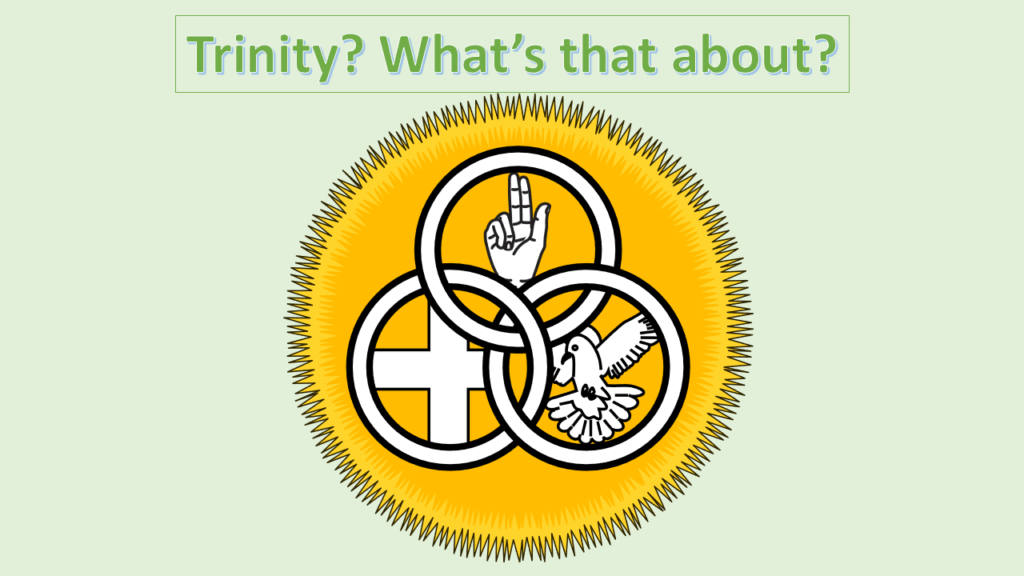
Today, the week after Pentecost, is marked by many churches as ‘Trinity Sunday’, when we think about the nature of God who is Father, Son and Holy Spirit. So let’s see what that belief in our three-in-one God might tell us about the assurance of faith with which we come to baptism.
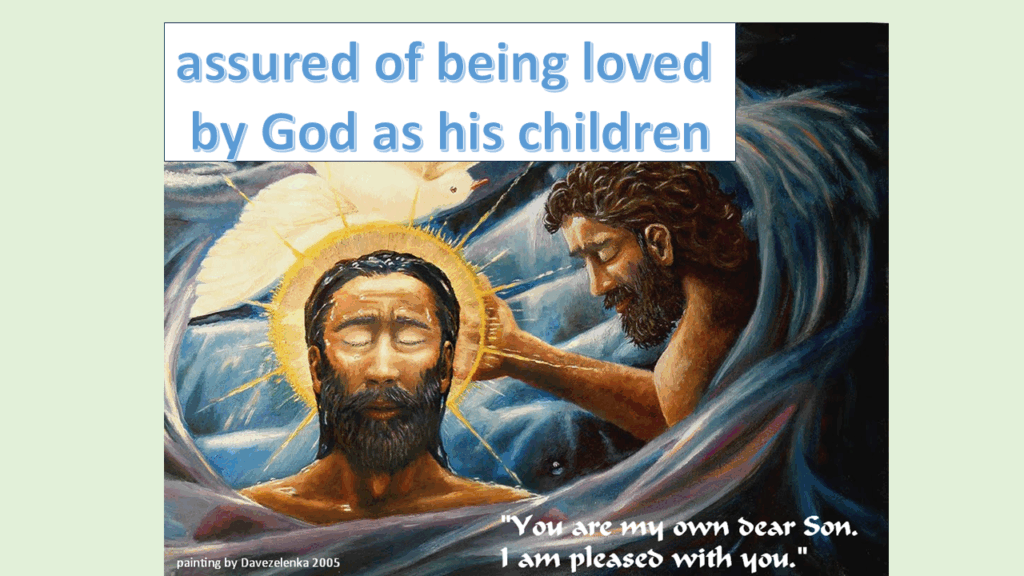
Firstly, we are assured of God’s love. Baptism is a sign that God assures us of being one of his children. When Jesus was baptised, God spoke to those watching and called Jesus his son whom he loved. Saint Mark places the baptism of Jesus right at the start of his gospel, to make it clear that it was a decisive moment, the point when Jesus came to know fully who he was – the Son of God. Jesus was fully assured that the God of his ancestors was his father, not just in a historical sense but as a living, ever-present companion.
Of course, we are not Sons of God in the same sense that Jesus was, and we don’t expect to hear God speaking aloud as Xavier and Colliopy are baptised. The New Testament writers, though, are convinced that if we believe in Jesus, we are in a very meaningful sense God’s children. Children who can know that our Father loves us, can feel that love, and that he is pleased with us. Saint Paul wrote: “God sent his Son … that we might receive adoption as children. Because you are children, God sent the Spirit of his Son into our hearts.”[ii] I have more to say about the Spirit shortly.
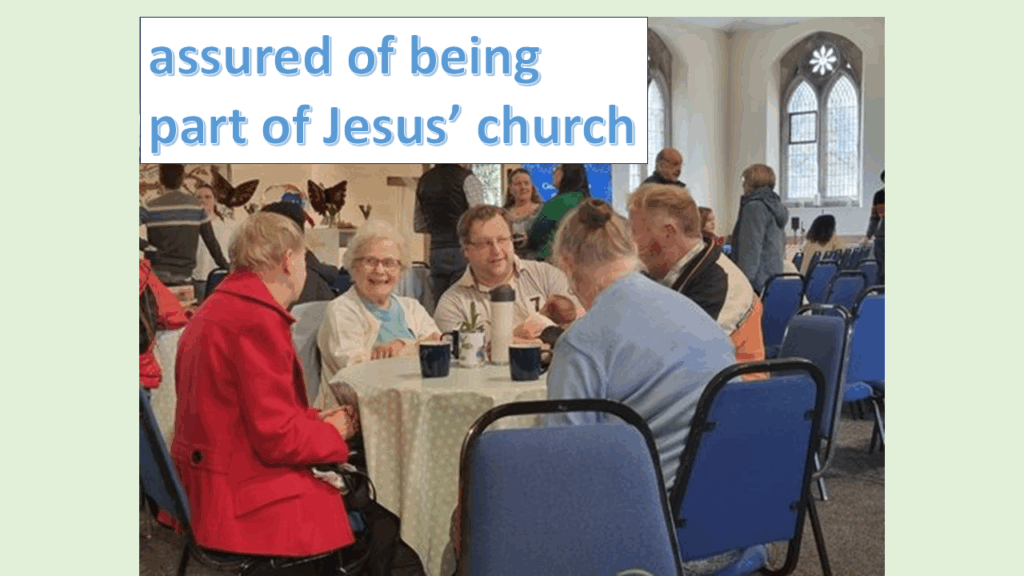
Secondly, we are assured of being part of the church of Jesus Christ. The word ‘church’ essentially means ‘community’. All of us present today will be asked to affirm that we will, with the help of God, welcome and uphold Xavier and Colliopy in their new life in Christ as they join our community.
Psychologists and historians agree that from the beginning, humans were made to live in small communities – neither totally alone, nor lost in a sea of humanity in a large city. The scale of an extended family or small village is what we were made for, and the local church is usually of that sort of scale.[iii] Studies also show that people who belong to a religious community are consistently happier than others. The church community, meeting each week to worship together, pray for each other and break bread, is an antidote to the loneliness and unhappiness of our anonymous digital world.
It is a common and regrettable thing to hear people say “you can be a Christian without going to church”. But no! We cannot expect to be fulfilled or fruitful as Christians by relying on the mere fact of having been baptised, even as adult believers. The early church that we read about in the Bible knew nothing of the solitary Christian: baptism was into the family of the church, and fellowship was everything. For it is the Church – existing worldwide but expressed mainly in the local congregation – that offers us the support we need. Support in the form of prayer, encouragement, practical help, opportunities to worship together, Bible study together.
Thirdly, we are assured of the guidance of the Holy Spirit. John the Baptist said that his baptism was “with a view to the forgiveness of sins”. But he also said that Jesus would follow him and baptise people “with the Holy Spirit and with fire”. So, it is not the act of baptism alone that brings us into God’s kingdom, nor is it belief in God and repentance for sin. The repentance is necessary, and baptism is our way of publicly showing it. But it is Jesus, acting in us by his Holy Spirit, who brings us into the Kingdom of God. It is the Spirit who first convinces us that we are sinners, and brings us to the point where we want to repent. It is the Spirit who shows us the life of Christ evident in other people in the Church, and brings us to the point where we want what they have got. It is the Spirit who fills us with joy and faith so that we want to express that faith publicly.
The Holy Spirit is also called the Comforter and the Counsellor, the one who assures us time and again that we are loved by God and part of his family. The Spirit also guides us how to live for God, day by day. Understanding the Bible is part of that, of course: it is a guide for right living. But it is the Spirit – the breath of God – who breathes life in to the words of the Bible and makes us hear God speaking to us through them.
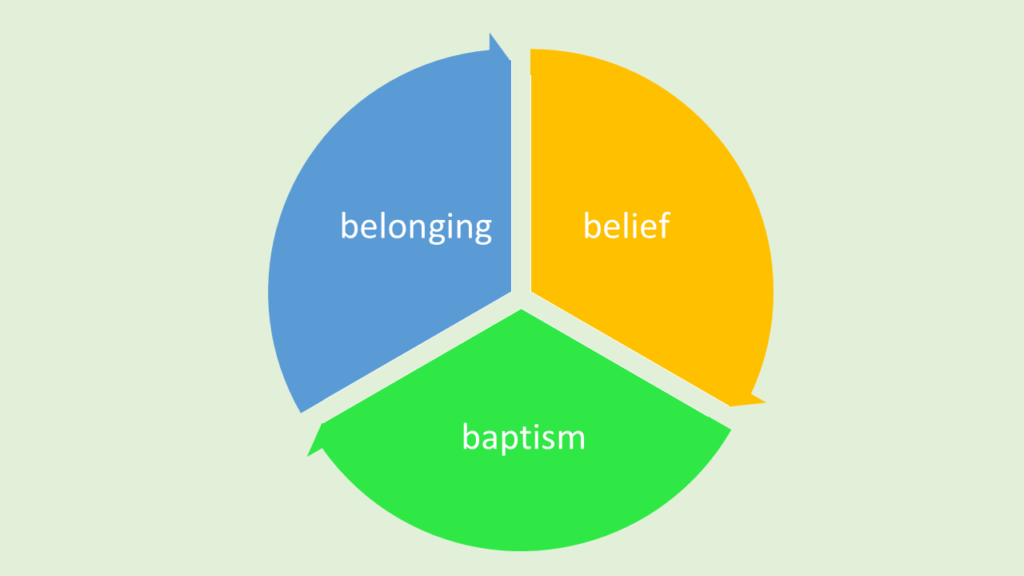
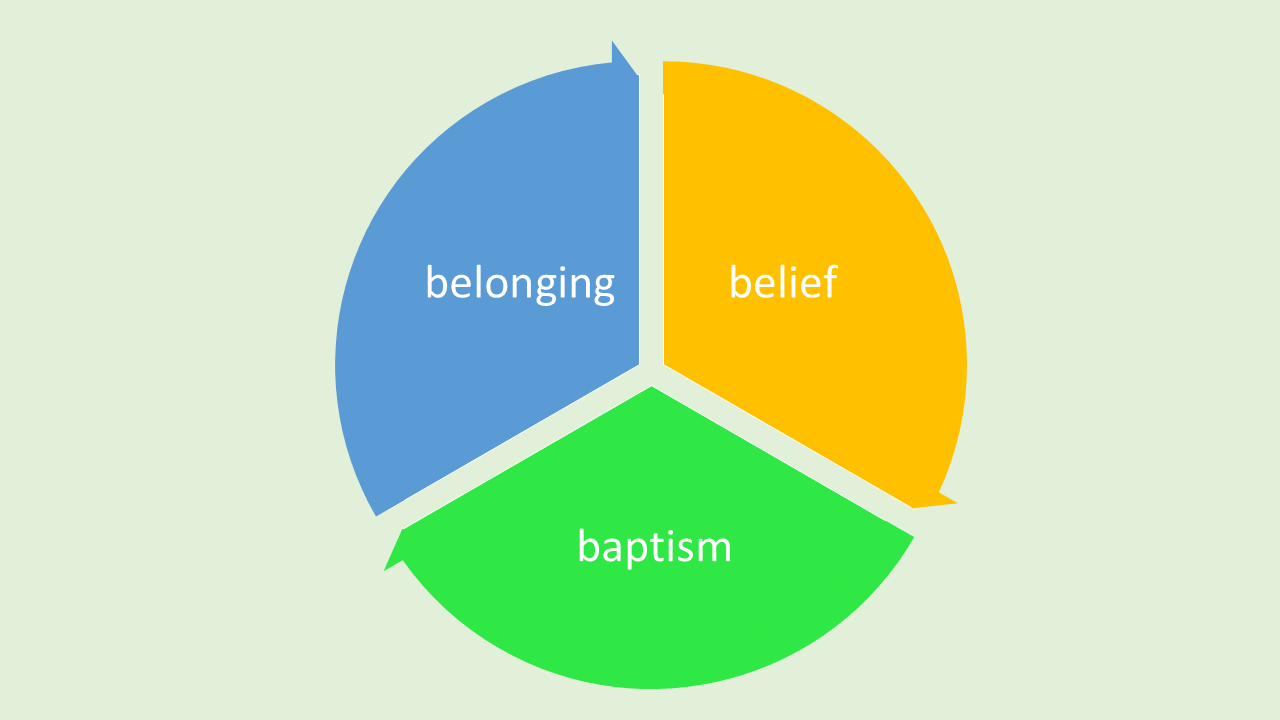
But which comes first – the assurance of being a child of God that we find when we come to believe in Jesus, or the assurance of support that we find in belonging to him as expressed through baptism in church, or the assurance of God’s guidance through the Holy Spirit? The answer in practice has to be ‘any of them’. The words of the baptism service quite deliberately use the language of journeying, as few people become Christians suddenly or remain unchanged in the strength and nature of their beliefs. There are many who have been baptised, either at their own request or as babies, and belong to a local church, who only find true faith and life in the Spirit later. Likewise there are those who have had a spiritual experience and come to believe in Christ, but who have not yet been baptised or joined a church. Belief, Baptism, and Belonging: all three come together to make us fully Christian. If you have not yet experienced all of these – if you think now might be the time to express belief in Jesus for the first time, or commit to joining our church, or be baptised, have a word with me or Julia after the service.
So, as we bring these two children to the font, may all of us present – baptised or not – hold on to these three assurances. Assurance that you are a child of God our heavenly Father. Assurance that in the Church of Jesus Christ, you have brothers and sisters who are here to supportyou. And assurance that God’s Holy Spiritis with you, comforting and guiding you on your journey of faith.
Let us pray…
Eternal God, our beginning and our end, preserve in your people the new life of baptism. As Christ receives us on earth, so may he guide us through the trials of this world and enfold us in the joys of heaven, where you live and reign, one God for ever and ever. Amen. [iv]
[i] Hebrews 10:22, NRSV
[ii] Galatians 4:4-6, NRSV
[iii] Fforde, M, ‘Desocialisation: the crisis of post-modernity’, Gabriel 2009, p 161-162
[iv] Prayer after Communion for a service of Holy Baptism, Common Worship p362.