
Peter in the house of Cornelius (Acts 10:34-48)
Sermon for 28 June 2026, St Peter’s Bramley
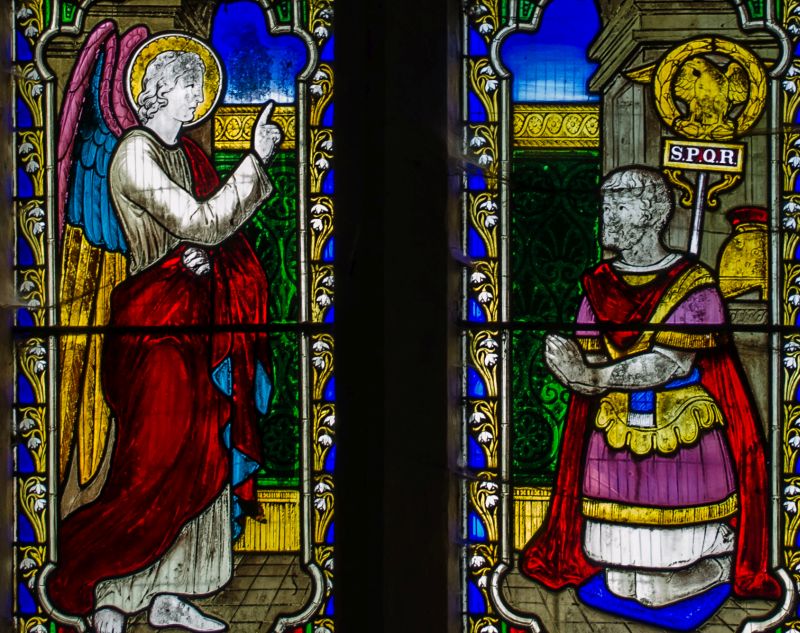
Featured image: Cornelius and the angel, detail of stained glass,
St Cuthbert's, Holme Lacy. Copyright Julian P Guffogg cc-by-sa-2.0
As we work our way through the book of Acts, we are looking at the different stories of people acting as witnesses to what Jesus had done, and could do. Ayo read for us not the beginning of a story, but the middle of it. So here’s the context. A couple of days earlier, God had sent an angel to Cornelius, telling him to send for Simon Peter to come from Joppa to Caesarea (just a day’s walk away) and explain how he could be saved.
While his servants were on their way there, God gave Peter a vision of a sheet full of animals. The animals in the sheet were those which it was forbidden to eat under Jewish religious law. Peter saw this as a temptation to be resisted and insisted he would never sin in this way. God’s reply is at the heart of the story, and indeed of the Gospel message: ‘Do not call unclean what God has called clean’. In other words, God’s direct message to him on that occasion overruled what was written in the Jewish scriptures and traditions.
It soon becomes clear that this vision of forbidden food is a parable, because almost immediately Cornelius’s servants arrive. Peter realises that after what has been said, God wants him to regard them – Gentiles, non-believers – as ‘clean’, so that it was OK to invite them in for a meal and to stay the night in his house. Wouldn’t this pair of visions make a great opening to a movie, showing the two appearances side-by-side? God preparing both men in the same way for their historic meeting.
And preparation was much needed. Peter was a Jewish Christian, Cornelius a Roman military commander. This was in a time of religious and ethnic division, even hostility – Jew against Gentile, Roman freemen against slaves and foreigners. Jews would not eat with Gentiles, and regarded Romans as particularly ungodly, because they worshipped the emperor as a god. Jews were in turn regarded with suspicion by Romans, who did not understand their religious practices. Neither side understood the other, for they had no opportunity to get to know one another.
Peter would therefore have assumed that Cornelius was a pagan, an emperor-worshipper – but he was not. He believed in the Jewish God, and was prayerful and generous. What God wanted to get across to Cornelius, through Peter, was that his pagan background did not count against him: righteousness through faith is open to people of any background.
God could simply have sent an angel to tell him that. Why complicate matters by bringing Peter in to deliver the message? It was because the lessons here were not just for Cornelius. Peter needed to hear a message too. ‘Not all Romans are like that’, was part of it, and more widely ‘God calls no-one unclean’. Peter was willing, in the light of the vision, to welcome the Romans, go with them and enter Cornelius’ villa, a completely new and daunting experience for him. Perhaps like the first time one of us is invited to enter a mosque or Hindu temple.
They meet as equals: Cornelius does not want this Jewish working man to kowtow to him as Peter might have expected. Think of another centurion and another Simon: Simon of Cyrene who was forced to carry Jesus’ cross. But nor does Peter accept Cornelius prostrating himself as if Peter were an angel. They talk together, as equals, even as brothers. That would have been incredible to the onlookers!
The gospel, after all that preparation, is not given as a lecture like Paul preaching to the Athenians in their forum. Nor as a sermon like Peter’s earlier speech to the crowds at Pentecost. It is person-to-person witness, based on Peter’s understanding of Jesus, but tailored to the occasion for one man who was already on the journey of faith. The mere fact of Peter mixing with a Roman centurion, his family and slaves, was as powerful as the witness of the words he spoke. He told them that they were welcome in God’s family, and showed that practically.
In this act of witness, both Cornelius and Peter would be changed in their understanding of God’s love, and open the way for the whole Church to do so. That’s what makes this such a key text in the story of the early Church. These new Roman believers received the Holy Spirit and spoke in tongues. They were baptised to become full members of the church. It was the clearest example yet, after Pentecost, that the Church of Jesus Christ is open to everyone who comes to believe.
What does this all mean for us?
All major religions today have sects who practice a very exclusive form of faith, cutting themselves off from contact with others, or denouncing anyone outside their sects as ungodly. Sadly, that includes some who call themselves Christian. But they are of course God’s people just like ourselves, and their faith in Christ as such is not in doubt.
Being suspicious of other people, though, isn’t limited to extremists. The Holy Spirit calls us to be witnesses to anyone, yet if we harbour any kind of prejudice or suspicion it will prevent us from being the witness that the Spirit requires.
Those suspicions and prejudices are not the same as outright racism. It might just that you don’t understand someone else’s language or culture, or religion. It might be not understanding the difficulties they face in their life. It is an area of life where most of us probably have room for improvement. And thank God, he loves us as we are, and will work with us to overcome these barriers.
Firstly, then, ask God to show you if there is any discrimination or suspicion in your heart, whether of class, race, religion or anything else, and repent of that. Then be willing to stand up for inclusion. God does not have favourites (as it says in verse 34) and the good news is for everyone.
Secondly, remember that God does the groundwork, as he did with Peter and Conelius! Continue to pray for people (including the five people you may have committed to pray for during ‘Thy Kingdom Come week’) and ask God for opportunities to speak to them about him. Have faith that whether they see it or not, God is preparing them for that same opportunity.
Thirdly, don’t think that if you are not the academic type, or not happy with speaking in public, God cannot use you in witness. Peter had not had much of an eduction, and it is the Spirit who gave him the right words to speak, based on his own experience. Of course we should learn the basics of the Christian faith to be able to give a brief summary of the Gospel (v. 39-43). But we should also ask the Holy Spirit to give us the right words for a particular occasion.
So, we should be open to the Holy Spirit speaking to us as he did to Peter. To challenge us where we are holding onto a wrong understanding of what it is to be God’s people. To prepare us in advance for encounters with people of a very different background to our own, so that we can be confident to welcome others whatever their background and identity. To go into what might otherwise be uncomfortable situations, knowing that God is with us to bless and change both us and other people through that encounter.
Let’s finish with a prayer:
Lord,
we commit ourselves to take a step of faith with you.
We commit ourselves to walk the path of service in Christ.
We commit ourselves to be open to the leading of the Spirit.
We commit ourselves to you and to each other.
Because you first committed yourself to us.
Amen.
David Clowes, ‘500 Prayers for all occasions’ #458